How Much Does Probate Cost by State?
Not sure whether probate is required?
Answer a few questions to see whether probate is likely required and which process usually fits.
Take the 2-minute assessmentCourt filing fees, small-estate limits, executor pay, and creditor periods for all 50 states in 2026, from statutes and our own estimates.
Probate is the court-supervised process that transfers a deceased person's assets to heirs and pays valid creditor claims. There is no federal probate system, so what it costs, and how long it takes, is decided state by state. The spread is wide: a court filing fee runs from $30 in New Mexico to $750 in Rhode Island, attorney fees follow a statutory or presumed schedule in seven states, and the creditor period that keeps an estate open runs from three months in Florida to a full year in Massachusetts and Pennsylvania.
This study compiles probate costs across all 50 states for 2026. It covers court filing fees, small-estate thresholds, and estimated attorney fees for every state, plus executor compensation rules and creditor claim periods for the 42 states where Settled Estate maintains a full verified dataset. Filing fees and statutory thresholds come from state statutes and county court fee schedules. Attorney-fee ranges are Settled Estate estimates, not sourced figures: for the 43 states without a statutory schedule they multiply a stated hours band by each state's average attorney hourly rate from the Clio Legal Trends Report, as the methodology below sets out in full. They are not quotes for any specific estate.
A boundary first: Settled Estate is not a law firm and this report is not legal advice. Statutes change, several dollar thresholds adjust for inflation, and the cost of any estate depends on its facts. Use this as a map, then confirm the current rule for your state before you rely on it. For your specific situation, consult a probate attorney. Settled Estate also offers paid probate-guidance plans; we publish this study as a free, fully sourced resource, and every figure here is yours to use whether or not you ever work with us.
Key findings
- The median court filing fee across all 50 states is about $233. The lowest is New Mexico at $30; the highest typical figure is Rhode Island at $750, which scales its fee to estate value and is shown here at a representative estate of about $150,000 (a smaller Rhode Island estate pays far less, down to a $30 minimum). Because that high end is a value-scaled fee and the low end is a flat one, treat the spread as an order of magnitude, not a precise multiple.
- The filing fee is almost never the real cost. Across the board it is the smallest line item. Attorney fees, executor compensation, and the time an estate must stay open drive the total.
- Seven states set ordinary attorney fees by a statutory or presumed schedule: California, Florida, Arkansas, Nevada, Iowa, Missouri, and Wyoming. The mechanics vary (California's is a fixed fee, Iowa's a cap, Missouri's a floor a court can exceed, Florida's is a presumed-reasonable schedule, and Nevada's, Arkansas's, and Wyoming's are schedules a court approves or adjusts), but in any of them a large estate can generate a fee far above what hourly counsel would charge elsewhere, and in California the attorney and the executor are each paid on the same schedule.
- Executor pay splits the country in two. Among the 42 states we cover in full, 22 set it by a percentage or cap you can calculate up front; the other 20 use a "reasonable compensation" standard with no fixed formula.
- Time is a cost. Among the 42 states we cover in full, 40 hold an estate open for a creditor period, most commonly 3 to 4 months, but longer in several: 6 months in Alabama, Arkansas, Illinois, Kentucky, Maryland, Missouri, New Hampshire, Ohio, and Rhode Island, 8 in Delaware and South Carolina, 9 in New Jersey, and 12 in Massachusetts and Pennsylvania. An estate generally cannot close and distribute until that window runs.
- The small-estate shortcut is the biggest lever, when it applies. Most states let estates below a threshold (from around $15,000 to as much as $400,000 in Wyoming) skip formal probate entirely. But most of these thresholds cover personal property only and exclude real estate, so the shortcut often does not help when an inherited house is the main asset; only a few states offer a separate real-property procedure.
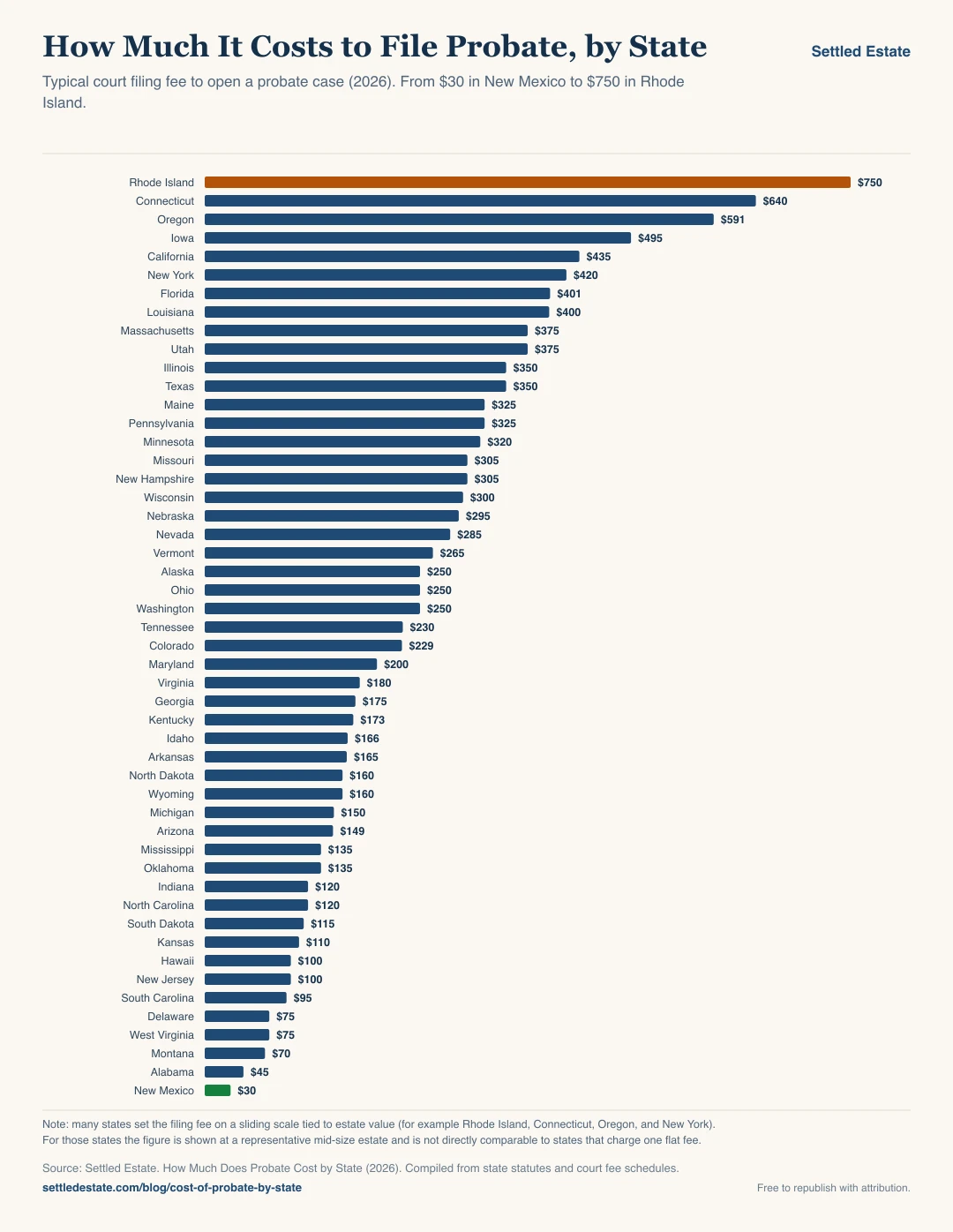
Typical court filing fee to open probate, 2026. The fee alone ranges roughly 25x across states, yet it is still the smallest part of the total cost. Free to republish with attribution (embed code below).
All 50 states: probate cost table
Sort or search the table for any state. These are statewide figures; for the current, county-level filing fee, follow the link in each row to that state's fee calculator.
Sortable. Select a state for the sources and the full breakdown.
| Settled guide | Details | ||||
|---|---|---|---|---|---|
| Alabama | $45-$175 | $47,000 | $2,500-$6,250 (est.) | Cost calculator | |
| Alaska | $250 | $50,000 | $3,250-$8,250 (est.) | Data only | |
| Arizona | $149 | $200,000 | $3,250-$8,000 (est.) | Cost calculator | |
| Arkansas | $165 | $100,000 | Statutory % | Cost calculator | |
| California | $435 | $208,850 | Statutory % | Cost calculator | |
| Colorado | $229 | $88,000 | $3,250-$8,000 (est.) | Cost calculator | |
| Connecticut | $150-$40,000 | $40,000 | $4,000-$10,250 (est.) | Cost calculator | |
| Delaware | $25-$1,400 | $50,000 | $4,750-$12,000 (est.) | Cost calculator | |
| Florida | $232-$401 | $75,000 | Statutory % | Cost calculator | |
| Georgia | $175-$215 | $15,000 | $3,750-$9,250 (est.) | Cost calculator | |
| Hawaii | $215 | $100,000 | $3,500-$8,500 (est.) | Cost calculator | |
| Idaho | $166 | $100,000 | $3,000-$7,750 (est.) | Cost calculator | |
| Illinois | $364-$479 | $150,000 | $3,500-$8,750 (est.) | Cost calculator | |
| Indiana | $177-$205 | $100,000 | $3,000-$7,250 (est.) | Cost calculator | |
| Iowa | $300 | $100,000 | Statutory % | Cost calculator | |
| Kansas | $110-$132 | $75,000 | $3,000-$7,750 (est.) | Cost calculator | |
| Kentucky | $70-$90 | $30,000 | $2,500-$6,250 (est.) | Cost calculator | |
| Louisiana | $250-$600 | $200,000 | $2,750-$6,750 (est.) | Cost calculator | |
| Maine | $40-$1,200 | $52,500 | $2,500-$6,250 (est.) | Cost calculator | |
| Maryland | $0-$10,000 | $50,000 | $3,500-$9,000 (est.) | Cost calculator | |
| Massachusetts | $115-$390 | $25,000 | $3,250-$8,500 (est.) | Cost calculator | |
| Michigan | $150 | $53,000 | $3,000-$7,500 (est.) | Cost calculator | |
| Minnesota | $310-$325 | $75,000 | $3,250-$8,250 (est.) | Cost calculator | |
| Mississippi | $135-$184 | $75,000 | $2,500-$6,250 (est.) | Cost calculator | |
| Missouri | $56-$665 | $40,000 | Statutory % | Cost calculator | |
| Montana | $70 | $100,000 | $2,500-$6,500 (est.) | Data only | |
| Nebraska | $44-$1,670 | $100,000 | $2,500-$6,500 (est.) | Cost calculator | |
| Nevada | $186-$538 | $25,000 | Statutory % | Cost calculator | |
| New Hampshire | $150-$305 | None | $3,000-$7,500 (est.) | Cost calculator | |
| New Jersey | $100-$125 | $50,000 | $3,750-$9,000 (est.) | Cost calculator | |
| New Mexico | $30-$132 | $50,000 | $2,750-$7,000 (est.) | Cost calculator | |
| New York | $1-$1,250 | $50,000 | $4,250-$10,750 (est.) | Cost calculator | |
| North Carolina | $120-$6,120 | $20,000 | $3,250-$8,000 (est.) | Cost calculator | |
| North Dakota | $160 | $100,000 | $3,250-$8,000 (est.) | Data only | |
| Ohio | $200-$300 | $35,000 | $2,750-$7,000 (est.) | Cost calculator | |
| Oklahoma | $195-$205 | $50,000 | $2,750-$7,000 (est.) | Cost calculator | |
| Oregon | $278-$1,176 | $75,000 | $3,250-$8,250 (est.) | Cost calculator | |
| Pennsylvania | $200-$450 | $50,000 | $3,000-$7,750 (est.) | Cost calculator | |
| Rhode Island | $30-$1,500 | $15,000 | $3,750-$9,250 (est.) | Cost calculator | |
| South Carolina | $25-$1,845 | $45,000 | $3,000-$7,500 (est.) | Cost calculator | |
| South Dakota | $115 | $100,000 | $2,500-$6,250 (est.) | Data only | |
| Tennessee | $230-$345 | $50,000 | $3,000-$7,500 (est.) | Cost calculator | |
| Texas | $75-$400 | $75,000 | $3,750-$9,250 (est.) | Cost calculator | |
| Utah | $375 | $100,000 | $3,250-$8,500 (est.) | Cost calculator | |
| Vermont | $50-$3,250 | $45,000 | $2,750-$7,000 (est.) | Cost calculator | |
| Virginia | $70-$1,030 | $75,000 | $3,750-$9,500 (est.) | Cost calculator | |
| Washington | $290 | $100,000 | $3,500-$8,750 (est.) | Cost calculator | |
| West Virginia | $44-$100 | $50,000 | $2,000-$5,000 (est.) | Cost calculator | |
| Wisconsin | $300 | $50,000 | $2,750-$7,000 (est.) | Cost calculator | |
| Wyoming | $235 | $400,000 | Statutory % | Data only |
Filing fees and small-estate limits are official figures from state statutes and court fee schedules. Attorney fees marked "(est.)" are Settled Estate estimates. Select a state for sources; see the methodology section below.
What actually drives the cost of probate
Put the pieces together and a realistic cost picture looks like this. The court filing fee is rarely the problem. The big variables are whether the estate can use a small-estate shortcut at all, what the executor and the attorney are paid, and how long the estate must stay open while costs accrue. Layer on real property, a bond, publication, and appraisals, or any dispute, and the gap between a clean small estate and a contested formal administration is enormous, even within one state.
As a rough order of magnitude, settling a straightforward, uncontested estate usually runs from a few thousand dollars to the low five figures: a filing fee in the low hundreds, an attorney fee our estimates put around $2,000 to $12,000 depending on the state, and, where it applies, executor compensation. A percentage-schedule state, a large estate, real property, or any dispute can push the total well above that.
Three practical takeaways:
- Check the small-estate threshold first. For estates that qualify, the simplified path is often the single biggest cost lever, though eligibility depends on the estate's assets and state law, and most thresholds exclude real estate. See the small estate affidavit page for your state's rule.
- In a percentage-schedule state, you can estimate fees up front. In a "reasonable compensation" state, the fee is typically set by agreement or court approval, and courts generally expect documentation of the work performed.
- Budget for time, not just fees. A longer creditor period means a longer administration and more carrying costs.
One more creditor can outweigh all the others. If the person who died received certain Medicaid benefits (generally long-term care, or benefits received at age 55 or older), the state can file an estate-recovery claim against the estate, often against the home, during the same creditor window, and the rules and exemptions vary widely by state. If that might apply, see our Medicaid estate recovery guide for your state.
What an executor can be paid
Executor compensation (called personal representative or administrator compensation in many states) is one of the largest costs in a formal probate, and states take two very different approaches. Among the 42 states Settled Estate covers in full, 22 set the pay by a percentage schedule or a hard cap. The other 20 leave it to a "reasonable compensation" standard, where a written agreement or the court decides. One row in the first group is not statutory: Virginia sets no fee by statute, and the declining percentage below is the Commissioners of Accounts guideline that the Commissioner applies when approving the amount.
States with a percentage or cap you can calculate up front
| State | How executor pay is set | Statute |
|---|---|---|
| Alabama | Up to 2.5% of receipts plus 2.5% of disbursements | Ala. Code 43-2-848 |
| Arkansas | 10% of the first $1,000, 5% of the next $4,000, and 3% of the balance (personal property) | Ark. Code 28-48-108 |
| California | 4% of the first $100,000, 3% of the next $100,000, 2% of the next $800,000, 1% of the next $9 million, 0.5% of the next $15 million | Cal. Prob. Code 10800 |
| Florida | Presumed reasonable: 3% up to $1 million, 2.5% to $5 million, 2% to $10 million, 1.5% above | Fla. Stat. 733.617 |
| Georgia | 2.5% of money received plus 2.5% of money paid out | O.C.G.A. 53-6-60 |
| Iowa | Court-allowed maximum: 6% of the first $1,000, 4% of the next $4,000, 2% of the balance | Iowa Code 633.197 |
| Kentucky | Up to 5% of the personal estate plus 5% of income collected | KRS 395.150 |
| Louisiana | 2.5% of the inventory (default succession-representative commission) | La. C.C.P. art. 3351 |
| Maryland | Up to 9% of the first $20,000 plus 3.6% of the excess | Md. Est. & Trusts 7-601 |
| Missouri | A statutory minimum a court may exceed: 5% of the first $5,000, 4% of the next $20,000, 3% of the next $75,000, then lower bands | Mo. Rev. Stat. 473.153 |
| Nevada | 4% of the first $15,000, 3% of the next $85,000, 2% above $100,000 | NRS 150.020 |
| New Jersey | 5% of the first $200,000 of corpus received, 3.5% to $1 million, 2% above | N.J.S.A. 3B:18-14 |
| New York | 5% of the first $100,000, 4% of the next $200,000, 3% of the next $700,000, 2.5% of the next $4 million, 2% above $5 million | SCPA 2307 |
| North Carolina | Clerk-set, up to a 5% commission ceiling | N.C. Gen. Stat. 28A-23-3 |
| Ohio | 4% of the first $100,000, 3% of the next $300,000, 2% above $400,000 (personal property and sale proceeds), plus 1% of unsold real property | ORC 2113.35 |
| Oklahoma | 5% of the first $1,000, 4% of the next $5,000, 2.5% above $6,000 | 58 O.S. 527 |
| Oregon | 7% of the first $1,000, 4% to $10,000, 3% to $50,000, 2% above, payable on application to the court | ORS 116.173 |
| South Carolina | Up to 5% of personal property plus real-property sale proceeds | S.C. Code 62-3-719 |
| Texas | 5% of cash actually received plus 5% of cash actually paid out | Tex. Est. Code 352.002 |
| Virginia | Commissioners of Accounts guideline (a declining percentage), approved by the Commissioner | Va. Code 64.2-1208 |
| West Virginia | 5% of the first $100,000, 4% to $400,000, 3% to $800,000, 2% above | W. Va. Code 44-4-12a |
| Wisconsin | 2% of the inventory value (default) | Wis. Stat. 857.05(2) |
Two of these schedules need a footnote. In New York, SCPA 2307 commissions are calculated on the sums the executor receives and pays out, not as a flat percentage of one estate value, so the rate tiers apply to those amounts. In Arkansas, the executor commission shown above and the attorney fee are set by different subsections of the same statute (Ark. Code 28-48-108), so they are two separate figures, not one.
States that use a "reasonable compensation" standard
| State | How executor pay is set | Statute |
|---|---|---|
| Arizona | Reasonable compensation, no fixed schedule | A.R.S. 14-3719 |
| Colorado | Reasonable compensation, no fixed schedule | C.R.S. 15-10-602, 15-10-603 |
| Connecticut | Reasonable compensation set by the Probate Court; no percentage anywhere in Title 45a | Probate Court Rules of Procedure rule 39 |
| Delaware | Reasonable compensation under a Court of Chancery rule rather than a statute; no fee table | Del. Ct. Ch. R. 192 |
| Illinois | Reasonable compensation, no fee schedule or percentage | 755 ILCS 5/27-1 |
| Indiana | A compensation clause in the will controls unless renounced before qualifying; otherwise court-allowed | IC 29-1-10-13 |
| Kansas | Necessary expenses and such compensation as the court allows; no percentage | K.S.A. 59-1717 |
| Maine | Reasonable compensation, reviewable by the probate court | 18-C M.R.S. 3-719 |
| Massachusetts | Reasonable compensation, reviewable by the Probate and Family Court | M.G.L. c. 190B, 3-719 |
| Michigan | Reasonable compensation, no fixed schedule | MCL 700.3719 |
| Minnesota | Reasonable compensation, no fixed schedule | Minn. Stat. 524.3-719 |
| Mississippi | Court-set by the value and difficulty of the work, no schedule | Miss. Code 91-7-299 |
| New Hampshire | Court rule governs fees and expenses; no percentage anywhere in the RSA | Circuit Court Probate Division Rule 88 |
| New Mexico | Reasonable compensation, no fixed schedule | NMSA 45-3-719 |
| Pennsylvania | Reasonable and just, no single statewide formula | 20 Pa.C.S. 3537 |
| Rhode Island | Such compensation as the court allows on the account; no fee table in Title 33 | R.I. Gen. Laws 33-14-8 |
| Tennessee | Court-set reasonable compensation, no schedule | T.C.A. 30-2-606 |
| Utah | Reasonable compensation; an unopposed petition can fix the amount | Utah Code 75-3-718 |
| Vermont | Necessary expenses and such fees as the court allows; no percentage | 14 V.S.A. 1065 |
| Washington | Court-allowed where the will makes no provision or the representative renounces it | RCW 11.48.210 |
The split is the headline. In a percentage-schedule state, a family can estimate the executor's fee up front: a $600,000 California estate carries an ordinary statutory commission of $15,000 to the executor under Probate Code 10800, and the estate's attorney is entitled to a matching $15,000 under the parallel schedule in Probate Code 10810, so the ordinary statutory fees come to about $30,000 before any extraordinary services (applied here to the full value for illustration; the actual base follows California's inventory rules). In a "reasonable compensation" state, the same estate has no published number, which can be a feature (a family member often waives the fee) or a friction point (the amount has to be justified to a court). The gap also widens with size: on a $1 million California estate the ordinary schedule produces about $23,000 for the executor and another $23,000 for the attorney, and on a $3 million estate it is roughly $43,000 each, which is why the statutory-schedule states matter most for larger estates. To see the figure for a value you enter, use the executor compensation tool for your state.
How long probate takes, and why it cannot finish sooner
Cost and time are linked: the longer an estate stays open, the more it carries in fees and administration. Even a simple, uncontested estate usually cannot close right away, because most states require it to stay open for a creditor claim period. During that window creditors can present claims, and an executor who distributes too early can be personally exposed. This is the clearest reason probate takes months even when nothing is in dispute.
Two different mechanisms hide behind the phrase "creditor period", and they are not interchangeable. In most states it is a claim bar: a creditor who misses the date loses the claim. In New York and Pennsylvania it is a distribution-protection period: claims are not extinguished, but once it runs the personal representative may distribute and is protected against claims they did not know about. Both keep an estate open; only the first ends the creditor's rights.
States where the period bars the claim
| State | Creditor claim period | Statute |
|---|---|---|
| Alabama | 6 months from the grant of letters, or 5 months from first publication, whichever is later | Ala. Code 43-2-350 |
| Arizona | 4 months | A.R.S. 14-3801, 14-3803 |
| Arkansas | 6 months | Ark. Code 28-50-101 |
| California | 4 months | Cal. Prob. Code 9100 |
| Colorado | 4 months | C.R.S. 15-12-801 |
| Connecticut | 150 days (about 5 months) | Conn. Gen. Stat. 45a-356(a) |
| Delaware | 8 months | 12 Del. C. 2102(a) |
| Florida | 3 months | Fla. Stat. 733.702 |
| Georgia | 3 months | O.C.G.A. 53-7-41(d) |
| Illinois | 6 months | 755 ILCS 5/18-3, 5/18-12(a) |
| Indiana | 3 months | IC 29-1-14-1(a) |
| Iowa | 4 months | Iowa Code 633.410 |
| Kansas | 4 months | K.S.A. 59-2239(1), 59-2236(a) |
| Kentucky | 6 months | KRS 396.011(1) |
| Maine | 4 months | 18-C M.R.S. 3-801 |
| Maryland | 6 months | Md. Est. & Trusts 8-103 |
| Massachusetts | 12 months | M.G.L. c. 190B, 3-803 |
| Michigan | 4 months | MCL 700.3801, 700.3803 |
| Minnesota | 4 months | Minn. Stat. 524.3-801 |
| Mississippi | 3 months | Miss. Code 91-7-145, 91-7-151 |
| Missouri | 6 months | RSMo 473.360 |
| Nevada | 3 months (60 days where the court grants summary administration) | NRS 147.040 |
| New Hampshire | 6 months | RSA 556:3 |
| New Jersey | 9 months | N.J.S.A. 3B:22-4 |
| New Mexico | 4 months | NMSA 45-3-801 |
| North Carolina | 3 months | N.C. Gen. Stat. 28A-14-1, 28A-19-3 |
| Ohio | 6 months | ORC Chapter 2117 |
| Oklahoma | At least 2 months | Okla. Stat. tit. 58, 331, 333 |
| Oregon | 4 months | ORS 115.005(2) |
| Rhode Island | 6 months | R.I. Gen. Laws 33-11-5(a) |
| South Carolina | 8 months (an outer period; see the note below) | S.C. Code 62-3-801, 62-3-803 |
| Tennessee | 4 months | Tenn. Code Ann. 30-2-307 |
| Texas | 4 months (4 years from death if no notice is published) | Tex. Est. Code 308.054 |
| Utah | 3 months | Utah Code 75-3-801(1)(a) |
| Vermont | 4 months | 14 V.S.A. 1203(a)(1) |
| Washington | 4 months | RCW 11.40.051 |
| West Virginia | 2 months | W. Va. Code 44-1-14a |
| Wisconsin | Court-set, at least 3 months | Wis. Stat. 859.01 |
States where the period protects the distribution instead
| State | Protection period | Statute |
|---|---|---|
| New York | 7 months from letters issuing | SCPA 1802 |
| Pennsylvania | 12 months from the first complete advertisement of the grant of letters | 20 Pa.C.S. 3532 |
The clock does not start in the same place everywhere, which matters more than the length. Most states run it from the first published notice to creditors, and known creditors usually get separate direct notice with a deadline of their own. But Delaware, Maryland, Massachusetts, New Jersey, and Ohio run it from the date of death, so it can be partly spent before anyone is appointed; California, Connecticut, Kentucky, and New Hampshire run it from the appointment, grant, or issuing of letters (California's four months run from the date letters are first issued, not from publication); and Georgia measures from the last published notice, Iowa from the second publication, and Oklahoma from the date the notice is filed. Several states also add an outer bar that runs from death regardless of notice, including Colorado, New Mexico, Utah, and Wisconsin at one year and Texas at four years. South Carolina is source-sensitive: the code carries an eight-month outer period alongside separate published and mailed notice rules, so treat the figure above as an outer bound rather than a single deadline.
Louisiana and Virginia are not in either table. Louisiana administers succession debts through the tableau of distribution rather than a fixed non-claim window, and Virginia's creditor-notice regime is optional, so neither publishes one period a reader could plan around.
The creditor period is only a floor. Outside estimates of total probate duration vary widely, commonly cited anywhere from around nine months to several years, because there is no central probate database and every estate differs. Contested wills, real property, tax filings, and missing heirs all add time. For the full sequence in one place, see the probate timeline for your state.
See your state's numbers
The figures above are the statewide picture and the governing rules. For the current filing fees and statutory figures in your state, including county-level detail, start here:
- Cost breakdowns: Florida, California, Texas, Ohio, Pennsylvania
- Fee calculators: Florida, California, Texas, Ohio, Pennsylvania
- National overview: Probate costs explained
How we compiled this
Coverage. This study reports court filing fees, small-estate thresholds, and estimated attorney fees for all 50 states. Executor compensation and creditor claim periods are shown for the 42 states where Settled Estate maintains a full verified dataset, the same data that powers our state fee calculators and guides.
Filing fees are taken from the fee schedules published by each state's court system or its highest-volume probate court. Where fees vary by county or estate size, we show a representative figure for a mid-size estate and note the range in each state's row. We do not show the lowest possible fee as the "typical" fee. About a third of states scale the filing fee to estate value; for those the figure is the fee at a representative estate of roughly $150,000, each such row says so, and direct comparisons of those particular fees are approximate. A few states (Virginia, for example) levy a probate tax rather than a flat court filing fee; we show that charge in the same column and label it in the row note. Several states set a base fee statewide but let counties add to it (Arizona, for instance, has a $149 statutory base but Maricopa County runs over $300), so where that happens we show the base and note the county range.
Small-estate thresholds come from the statutes that authorize a simplified affidavit or summary procedure. Where a state has more than one threshold (for example, separate rules for personal property versus real property), we show the primary threshold a family would encounter. Most cover personal property only and exclude real estate, and a surviving spouse often gets a higher limit.
Attorney fees are Settled Estate estimates, not quotes for any specific estate. For the 43 states without a statutory attorney-fee schedule, we estimate the ordinary fee for a straightforward, uncontested estate as 10 to 25 hours of attorney time multiplied by that state's average attorney hourly rate from the Clio Legal Trends Report (2025 data), rounded to the nearest $250. The hours band is our stated assumption; the hourly rate is an external benchmark, so the same method applies to every state and any figure can be reproduced. This is an estimate for comparison, not a measured survey and not a quote: a simple estate needs fewer hours and a complex or contested one far more, the rate we use is the general all-practice average rather than a probate-specific rate, and many probate attorneys bill a flat fee or a percentage instead of by the hour. For the seven states that set ordinary fees by a statutory or presumed schedule (California, Florida, Arkansas, Nevada, Iowa, Missouri, Wyoming), we instead apply that schedule to a $400,000 estate (the resulting figure is in the downloadable dataset). The mechanics vary: California's is a fixed fee, Iowa's a cap, Missouri's a floor a court can exceed, Florida's is a presumed-reasonable schedule, and Nevada's, Arkansas's, and Wyoming's are schedules a court approves or adjusts.
Executor compensation and creditor periods are tied to the governing statute in the tables above and maintained against primary sources. Several figures adjust on a schedule: California's small-estate threshold adjusts every three years (next on April 1, 2028), and Michigan's adjusts annually, among others. Filing fees and statutes can change at any time. Treat this as a current snapshot for 2026, not a permanent reference.
Last verified: September 10, 2026.
Cite or republish this study
Settled Estate, How Much Does Probate Cost by State (2026).
This data and the chart above are free to republish with attribution and a link back to this page. To embed the chart, copy this code:
<a href="https://settledestate.com/blog/cost-of-probate-by-state/">
  <img src="https://settledestate.com/images/blog/probate-filing-fees-by-state-2026.webp"
       alt="Court filing fee to open probate by state, 2026 (Settled Estate)" width="540">
</a>
<p>Source: <a href="https://settledestate.com/blog/cost-of-probate-by-state/">How Much Does Probate Cost by State (2026), Settled Estate</a></p>
The full dataset is also available as a downloadable CSV, with the governing source URL for every filing fee and threshold.
If you reference the figures, please note that filing fees are drawn from official sources (value-based fees are shown at a representative estate size) and attorney-fee ranges are Settled Estate estimates.
About the author
By Evan Reid, founder of Settled Estate. Evan built and maintains Settled's 50-state probate cost database, drawing on state statutes, county court fee schedules, and published attorney-rate benchmarks, to make the cost of settling an estate clearer for families. Read more on the Evan Reid author page or about Settled Estate. Settled Estate is not a law firm and does not provide legal advice, and it offers paid probate-guidance plans; the figures here are general information, free to use, not a quote for any specific estate.
Frequently asked questions
How much does probate cost on average?
Court filing fees in most states fall in the low hundreds of dollars, and the median across all 50 states is about $233. The larger cost is usually attorney and executor fees, which range widely by state and estate size. Seven states set ordinary attorney fees by a statutory or presumed schedule.
Which states are the most and least expensive for probate?
Among the 50 states in this study, New Mexico has the lowest typical court filing fee at $30 and Rhode Island the highest at $750 (Rhode Island scales its fee to estate value). The median is about $233. Seven states set ordinary attorney fees by a statutory or presumed schedule: California, Florida, Arkansas, Nevada, Iowa, Missouri, and Wyoming, where a large estate can trigger a fee far above what hourly counsel would charge elsewhere.
How long does probate take?
Even a simple, uncontested estate usually cannot close right away, because most states keep it open for a creditor claim period. That window runs 3 to 4 months in many states but runs longer in several: 6 months in Alabama, Arkansas, Illinois, Kentucky, Maryland, Missouri, New Hampshire, Ohio, and Rhode Island, 8 in Delaware and South Carolina, 9 in New Jersey, and 12 in Massachusetts and Pennsylvania. In most states missing it bars the claim; in New York and Pennsylvania it instead protects the representative who distributes after it runs. Outside estimates of total duration vary widely, commonly from around nine months to several years, depending on the estate and the state.
How much can an executor be paid?
It depends on the state. Among the 42 states Settled covers in full, 22 set executor or personal representative pay by a statutory percentage schedule or cap (for example California's tiered schedule under Probate Code 10800, or Texas at 5% of cash received and 5% paid out). The others use a "reasonable compensation" standard, where a court or written agreement sets the amount.
Is the court filing fee the main cost of probate?
No. The filing fee is usually the smallest line item, often a flat few hundred dollars. The bigger costs are attorney fees and executor compensation, plus publication, certified copies, appraisals, and bond when required, and the carrying costs of keeping an estate open through the creditor period.
Frequently asked questions
How much does probate cost on average?
Which states are the most and least expensive for probate?
How long does probate take?
How much can an executor be paid?
Is the court filing fee the main cost of probate?
How to cite this study
Journalists and researchers are welcome to cite and link to this study. Please attribute it to Settled Estate and link to this page. Check the source notes and methodology above for each figure, including any estimates or assumptions.
Settled Estate (2026). How Much Does Probate Cost by State?. Retrieved from https://settledestate.com/blog/cost-of-probate-by-state
Permanent link: https://settledestate.com/blog/cost-of-probate-by-state
Related Resources
How Much Does Probate Cost by State?
Court filing fees, small-estate limits, executor pay, and creditor periods for all 50 states in 2026, from statutes and our own estimates.
What It Costs to Hold an Inherited Home, by State
A 50-state plus DC study: what it costs to hold an inherited house in property tax and insurance during probate, from about $3,000 to nearly $13,000 a year.

Who Inherits If You Die Without a Will? Intestacy Laws by State
If you die without a will, state intestacy rules decide who inherits. In 30 states and DC, a child from another relationship shrinks your spouse's share.

How to Get Letters Testamentary in Ohio (Letters of Authority)
Ohio letters of authority let an executor access accounts, sell assets, and settle the estate. ORC 2113.06 qualification, bond, and certified copies.