Compare Settled software
Compare Settled software with other executor tools by cost, accounting, sharing, and support. This Settled Estate comparison covers five alternatives, from spreadsheets to services with human help.
Executor software at a glance
Scroll across to compare all columns.
| Situation | Start with | Reason to consider it | Question to resolve |
|---|---|---|---|
| One family estate, one-time price, broad working record | Settled | Tasks, assets, contacts, documents, ledger records, reports, and collaborator access for $19.99 once in 50 published states and D.C. See the published offer. | Does Settled publish guidance for the estate state, and is file-based transaction import enough? |
| Many transactions or formal accounting needs | EstateExec | Purpose-built estate accounting, reports, direct bank transaction download, and view or edit sharing. Read its accounting page. | Is the $199 estate license and any later bank-download fee justified by the financial workload? |
| Free access with limits to confirm, or broad published geographic reach | SwiftProbate | The vendor advertises a free level and a $39 paid level; confirm the free task limits in the note below. Check its current tier list. | Which paid features do you need, and how much detail do its accounting outputs provide for your matter? |
| Task guidance with an assistant and document vault | Executor.org | The public offer pairs a plan, assistant, state forms, reminders, and vault at $96 billed annually. Check current billing. | Will you use it long enough for annual billing to matter, and do you need a detailed financial workflow? |
| Human support and help locating forms | Atticus | Its family product pairs software with weekday Estate Expert support and a large advertised forms library. Review the family offer. | Ask Atticus to map the quoted price to the exact plan contents before paying. |
| Small estate and confident spreadsheet owner | Excel or Google Sheets | Full control over columns, formulas, and local filing habits, with no estate-software purchase. | Who owns the workbook, checks formulas, preserves receipts, tracks deadlines, and produces the final report? |
A low price does not settle the choice by itself. A $19.99 workspace may cost less than a yearly plan, yet a busier estate can make direct bank download worth more than the price gap. Human support can also change the decision. Atticus belongs in a service comparison as much as a software comparison because its public promise includes access to people.
How we compare Settled software and alternatives
We use the same six-part rubric for every option. We do not assign stars or a numerical rank because we have not purchased and exercised every paid product. The rubric exposes the trade instead of hiding judgment in a score.
Scroll across to compare all columns.
| Criterion | What we look for | Why it changes the choice |
|---|---|---|
| Task guidance | A plan shaped by estate facts, dated work, instructions, and links to source material. | A generic checklist can omit local or asset-specific work. Software guidance still needs court, agency, or counsel verification. |
| Estate records | Assets, debts, contacts, documents, notes, status, and an export path. | The executor needs a durable record after individual tasks are checked off. |
| Money workflow | Transactions, expenses, reimbursements, distributions, import method, calculations, and reports. | An estate with one checking account and ten payments differs from one with sales, gains, many beneficiaries, and hundreds of entries. |
| Sharing | Who can enter data, who can only view, and whether access costs more. | A co-executor, lawyer, accountant, and beneficiary may need different levels of access. |
| Help | Technical support, informational guidance, access to a person, and a clear boundary around legal advice. | A tool can organize work without deciding a disputed legal question. |
| Cost and access | One-time or recurring price, free boundaries, refund terms, state reach, and export access. | Estate work can last longer than a year, and advertised monthly prices may require annual payment. |
This follows the evidence principles in Google Search Central's review guidance: name the evidence, discuss drawbacks, compare alternatives, and explain what separates them. Our ownership interest also matters. Settled is our product. No competitor pays us, and commission does not affect this comparison.
What are the limits of each option?
Every choice gives something up. These are decision limits, not claims that a product is poor.
Settled
- Settled currently supports 50 states and D.C., so a user must confirm the estate state is included.
- Transaction import uses files or pasted data rather than a live bank feed.
- Settled collaborators can edit estate information. It does not offer a read-only heir portal.
- The workspace provides general information and records. It does not give legal advice or promise that an output will satisfy a court.
EstateExec
- The regular license costs $199 per estate after the published 10-day trial.
- Direct bank download costs $19.99 per year after the included first year.
- Its breadth may ask more setup and financial detail than a small, low-activity estate needs.
- Published guidance and calculations still cannot decide a disputed legal or tax question for the executor.
SwiftProbate
Free-plan check, September 27, 2026: SwiftProbate's pricing section lists task interaction and tracking, while its FAQ describes a sample task list for one asset. We have not tested an account to resolve that difference. Confirm the asset and task limits before deciding that its free plan covers your work.
- Documents, accounting exports, family collaboration, and chat support sit in the paid tier rather than free access.
- Its public feature page makes broad claims about deadlines and filing output that a user should verify for the estate and court.
- We did not buy the paid tier, so we cannot compare report detail or permission controls from direct use.
- Its comparison page contains an older description of Settled's state reach, so use each vendor's current product page for current facts.
Executor.org
- The advertised $8 monthly figure is billed as $96 for a year.
- The pages we reviewed focus on plans, forms, an assistant, reminders, and a vault; they do not give enough detail to judge a full estate-accounting report.
- An assistant's answer still needs verification with the relevant court, agency, or lawyer.
- We did not open an account, so we cannot assess assistant answer quality or vault sharing controls.
Atticus
- The family page shows $499 and “plans starting at $175” without a clear public mapping of price to tier contents.
- Live Estate Experts work during stated weekday hours rather than around the clock.
- A support-led service costs more than the one-time self-directed software options listed here.
- Estate Expert help is different from legal representation; confirm the boundary for the question you need answered.
Spreadsheets
- You must design categories, formulas, status rules, and reports.
- A row does not create a task dependency, deadline rule, or document trail by itself.
- Sharing one editable workbook can expose formulas and private estate details to accidental change.
- You must preserve versions and supporting files so the numbers remain explainable.
A practical way to make the choice
List the estate's likely work before opening product tabs. Count bank and brokerage accounts, expected sales, debts, beneficiaries, helpers, and states connected to the property. Mark whether you expect a formal accounting, regular questions for a person, or a need to give someone view-only access.
- Check state fit. A nationwide claim can describe resource coverage, software availability, or both. Confirm the actual estate workflow for the relevant place.
- Check the money path. Ask how transactions enter, how corrections work, how assets sold for gains or losses appear, and what the final report contains.
- Check access. Ask whether invited people can edit, view, export, or see every document. Do not treat “family sharing” as a single permission model.
- Check the full price. Multiply recurring prices by the expected term and include add-ons such as bank download. Get an exact quote when the public tier table is unclear.
- Keep legal judgment outside the product contest. A lawyer may be warranted when authority, deadlines, taxes, title, creditor disputes, or beneficiary conflict are uncertain.
Then read the focused comparison that matches the decision: Settled versus EstateExec for accounting depth, Settled versus SwiftProbate for similarly priced self-directed tools, Settled versus Executor.org for annual guided software, Settled versus Atticus for software versus human support, or software versus spreadsheets for a manual workflow.
Before entering real estate data, use a fictional record to test the full loop. Add an asset, expense, document, changed date, and proposed distribution. Invite only a safe test collaborator. Then correct one entry and export the result. This reveals whether the product preserves context, permissions, and an understandable history. It also shows which work still needs a separate calendar, file folder, spreadsheet, accountant, or lawyer.
Keep the comparison dated. A vendor may change coverage, price, free access, renewal, import, or support between this review and purchase. Save the pricing page or agreement used for the decision, and recheck any feature that determined your choice. Our source list identifies the public page reviewed on September 9, 2026.
Ask for a record, not a feature label
Turn each product claim into a concrete request. If a page says “estate accounting,” ask to see an opening asset, later sale, executor-paid expense, reimbursement, income entry, debt payment, partial distribution, and closing balance in one report. Ask how the system corrects a duplicate import and whether the correction remains understandable later. EstateExec publishes the most detail in this area, while other vendors require more questions.
If a page says “family sharing,” name three people: a co-executor who enters records, a lawyer who reviews work, and a beneficiary who receives updates. Ask what each person can view, change, download, and delete. Ask whether a person sees private notes or documents and whether access can be revoked. EstateExec publishes view and edit choices. Settled collaborators can edit. Public pages for other choices need closer permission checks.
If a page says “state-specific,” ask which facts shape the result. The estate state, appointment date, publication date, asset location, will status, property type, and procedure may change the work. Ask where the legal source appears and when it was checked. A nationwide resource library may have broad reach while a paid workspace has a narrower state boundary, so confirm access inside the actual product.
If a page says “support,” ask who answers, during which hours, under which plan, and with what credentials. Ask what happens when the question requires legal or tax judgment. Atticus advertises a live weekday team. Executor.org and SwiftProbate emphasize assistants or chat. Those are different forms of help, and the right one depends on whether the user needs navigation, product help, administrative explanation, or licensed advice.
Finally, ask about departure. Download a sample report and data export before committing real records. Check whether files keep meaningful names, whether transaction categories survive, and whether access continues after a refund, cancellation, or renewal date. A tool that feels easy at intake can create hard work later if the executor cannot hand a clear record to a co-executor, accountant, lawyer, or successor.
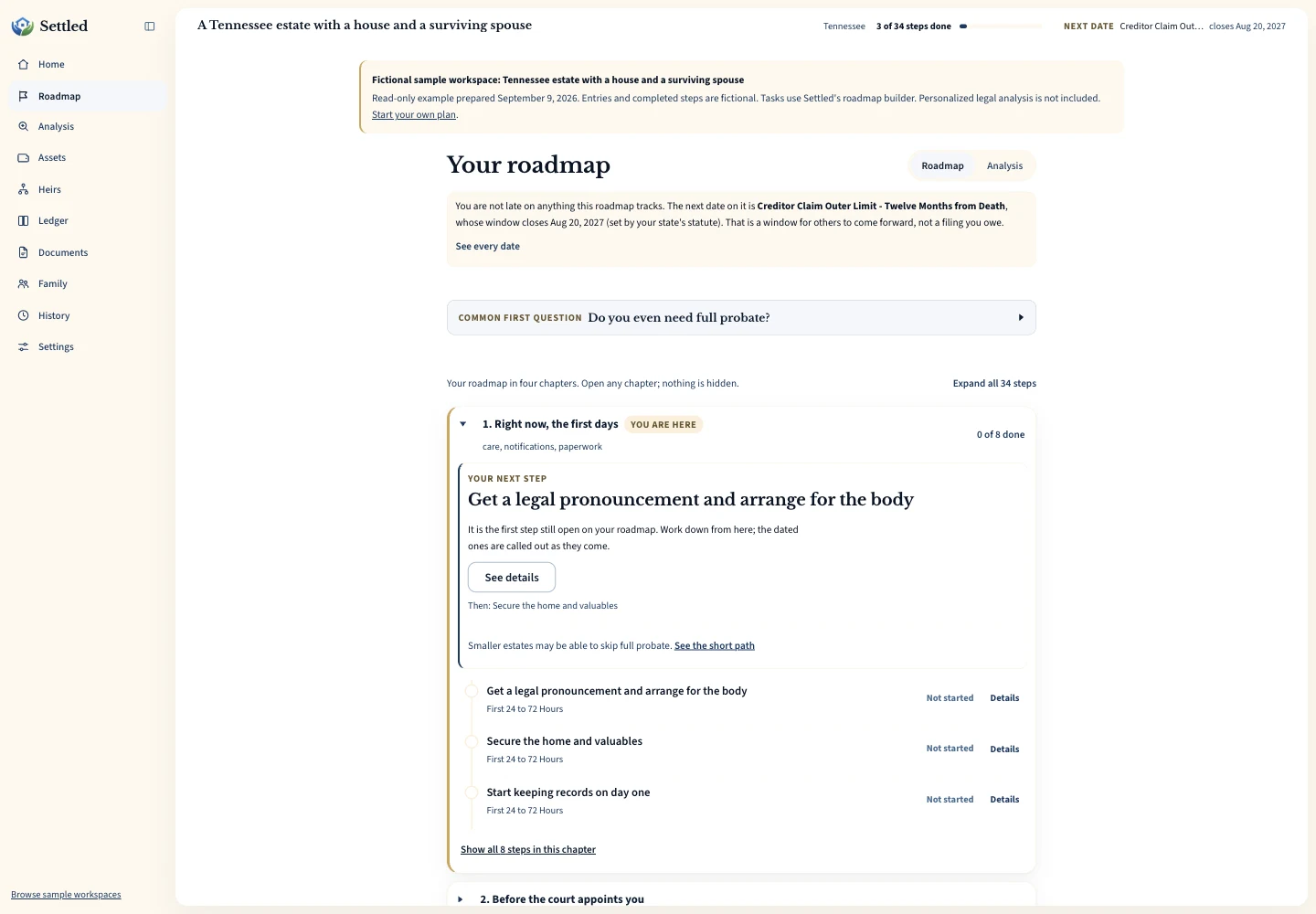
Explore Settled before you choose
Browse a read-only fictional estate, or see how the workspace works. These sample records are not a court filing.
Full workspace: $19.99 once per estate. See what is included.
Sample downloads: PDF summary · CSV ledger · data export
Frequently Asked Questions
Does Settled pay to appear first in these comparisons?
What is the cheapest executor software here?
Can executor software replace a probate lawyer?
Why are there no star ratings?
Can I move my records out later?
Settled Estate is not a law firm, and this content is for informational purposes only and does not constitute legal advice. Probate laws and procedures in your state can change. Consult with a qualified attorney for advice specific to your situation. Full disclaimer.