Best executor software for different estate needs
Best executor software depends on the estate. Settled Estate offers a $19.99 family workspace in 50 states and D.C. EstateExec emphasizes accounting; SwiftProbate offers free access; Executor.org offers guided help; Atticus adds human support. Settled price checked October 1, 2026; competitors reviewed September 9, 2026.
Free preview and 10 assistant questions. Working tools cost $19.99 once per estate. See what is included.
By Settled Estate Editorial Team · Checked
No single tool wins every executor job. We recommend by use case because a low-activity family estate, a transaction-heavy estate, and an executor who needs a person have different requirements. Settled Estate owns Settled. None of the named competitors pays us, and commission does not decide these recommendations.
What we checked. This is an original fit analysis, not a hands-on ranking. We inspected Settled code and focused tests, then checked each competitor’s public product and pricing pages on September 9, 2026. We did not buy competitor plans or test their paid workspaces.
Best executor software choices by use case
Our recommendations begin with the strongest supported distinction for each option. They are scoped choices, not an overall league table. Public feature claims can change, so confirm the current state, price, tier, export, and support terms before paying.
Scroll across to compare all columns.
| Use case | Starting choice | Why it fits | Published price |
|---|---|---|---|
| One family estate needing a combined working record | Settled | Tasks, assets, heirs, documents, transactions, expenses, distributions, collaborators, and exports in one estate across 50 current states and D.C. | $19.99 once per estate |
| Advanced estate accounting or direct bank download | EstateExec | Published bank download, integrated financial records, inventory and accounting reports, cost-basis features, fee calculations, and view or edit sharing | $199 once per estate; bank download $19.99 yearly after the included first year |
| Try a personalized task workspace before paying | SwiftProbate | SwiftProbate offers free access, but its public pages describe the free tier differently. Confirm the current limit before relying on the free plan. | $0 access with task limits to confirm; $39 Complete once |
| Guided plan with a conversational assistant | Executor.org | Questionnaire, ordered tasks, instructions, forms, time estimates, reminders, assistant, and Data Vault | $8 monthly display, billed $96 annually |
| Software paired with weekday human support | Atticus | Forms help, records, and live Estate Experts for an executor who wants a person in the process | Page shows $499 and plans from $175; exact tier mapping unclear |
| Small estate with an experienced recordkeeper | Spreadsheet | Full control and no estate-software purchase, when the owner can design, audit, share, and preserve the workbook | Depends on existing spreadsheet access and the owner’s time |
The biggest divide is between organization and judgment. Every option can help arrange information. None becomes the lawyer, court, accountant, or executor. A product that displays a form or deadline still leaves the user responsible for confirming what applies.
What rubric did we use for executor software?
We defined six criteria before making recommendations. We do not convert them into a score because the evidence basis differs between Settled and the competitors, as the note above explains. A numerical score would conceal that evidence gap.
Scroll across to compare all columns.
| Criterion | Evidence we seek | Buying question |
|---|---|---|
| Guidance | Estate-shaped tasks, dates, instructions, official links, and a correction path | Does the plan change when the estate facts change? |
| Records | Property, people, debts, documents, notes, task proof, and durable exports | Can another person understand what happened months later? |
| Accounting | Transactions, imports, classifications, reimbursements, sales, gains and losses, distributions, and reports | Can the tool produce the records this estate must explain? |
| Sharing | Clear edit, view, export, revoke, and privacy controls | Can each helper see and change only what is appropriate? |
| Help | Technical support, product guidance, human help, sources, and a boundary around legal advice | Who answers when the user cannot translate a task into action? |
| Cost and access | Full payment timing, renewal, add-ons, free limits, state reach, refunds, and retained access | What will the estate pay through the end of the work? |
This approach reflects Google Search Central's product-review guidance, which asks publishers to show evidence, name benefits and drawbacks, and explain which choices fit different uses. Our own-interest disclosure sits above the first recommendation because Settled is our product.
What does each executor option do well?
Settled: one family estate workspace
Settled connects an estate plan to assets, heirs, contacts, documents, reminders, collaborators, transactions, expenses, reimbursements, distributions, accounting views, downloadable summaries, and data export. Users can download entered data as CSV or JSON without payment. The $19.99 purchase adds full generated task details and PDF summaries. File import accepts CSV, TSV, or pasted data in groups of up to 500 rows. See the published offer.
The fit is a self-directed executor who wants the work and record together. Its current 50-state and D.C. boundary matters. So do the lack of a live bank feed and the fact that collaborators can edit estate information.
EstateExec: deeper accounting
EstateExec publishes the broadest financial feature list reviewed here: direct bank transaction download, integrated asset and cashflow records, inventory and accounting reports, cost-basis features, executor fee calculations, PDF and CSV exports, plus view or edit sharing. Its price is $199 once after a 10-day trial. See its accounting description.
The fit is a busy estate or professional-style accounting need. The user pays more, bank download becomes a yearly add-on after year one, and the wider setup can exceed what a small estate needs.
SwiftProbate: confirm the free task limits
SwiftProbate advertises free access; the note below explains the difference between its public free-plan descriptions. Complete costs $39 once and adds automated research, deadlines, documents, accounting and exports, family collaboration, chat support, and lifetime account access. It advertises nationwide availability. See current tiers.
Free-plan check, September 27, 2026: SwiftProbate's pricing section lists task interaction and tracking, while its FAQ describes a sample task list for one asset. We have not tested an account to resolve that difference. Confirm the asset and task limits before deciding that its free plan covers your work.
The fit is someone who wants to test task work before paying. Paid accounting details and permissions were not available for direct inspection, and broad legal or filing statements require official verification.
Executor.org: assistant-led guidance
Executor.org describes a questionnaire, ordered plan, task instructions, document lists, time estimates, state forms, reminders, an assistant, and a Data Vault for contacts, property, accounts, and files. Its displayed $8 monthly price is billed as $96 per year. See its published workflow.
The fit is someone who values guided answers and task explanation. We did not test assistant accuracy, and its public pages do not give enough detail for a full accounting comparison.
Atticus: human help with the process
Atticus pairs a family product with form finding, form autofill, records, document help, and live Estate Experts during stated weekday hours. Its page says the service is available across the United States and Canada. It shows $499 and plans starting at $175 without clearly mapping plan contents. See the current family page.
The fit is an executor who values a person more than the lowest software price. Ask about credentials, advice boundaries, contact limits, and exact tier contents.
Spreadsheets: full control
A workbook can fit a small estate with few transactions, one careful owner, and known reporting requirements. It supports custom columns and formulas without moving data into another estate platform. The owner must build task logic, permissions, document links, version history, validations, and reports.
What are the main limitations of each choice?
A credible shortlist needs negatives with the same prominence as benefits. These are the material limits supported by our evidence.
Settled limitations
- Only 50 states and D.C. are currently available.
- Transactions enter by file, paste, or hand rather than a live bank connection.
- Collaborators can edit estate information, so they may have more access than a beneficiary needs.
- The public sample is read-only, and product output is not court approval.
EstateExec limitations
- The $199 license costs more than the lower-priced self-directed choices.
- Bank download costs $19.99 yearly after the first included year.
- Financial breadth may create setup that a low-activity estate does not need.
- Vendor calculations and guidance still require legal, tax, and statement review.
SwiftProbate limitations
- Documents, accounting, sharing, and chat require the paid tier.
- Public pages do not establish import mechanics or report detail well enough for a field-level match.
- Its comparison page has an older Settled coverage statement.
- We did not test the paid product, permissions, exports, or assistant.
Executor.org limitations
- The monthly display requires annual billing.
- Public pages do not explain a complete transaction and estate-accounting workflow.
- Sharing permission details are not clear enough for a direct comparison.
- We did not test assistant answers, citations, or paid vault behavior.
Atticus limitations
- Public price figures are not mapped clearly to plans.
- Live human help follows stated weekday hours.
- “Estate Expert” does not alone establish legal representation or credentials.
- Public accounting and permission detail is too thin for a feature-level match.
Spreadsheet limitations
- The owner creates and audits every formula, category, and validation.
- Tasks and dates do not adapt unless the owner programs them.
- Editable sharing can expose formulas or private details to accidental change.
- Documents, versions, and final reports need a separate naming and preservation system.
How would these choices handle the same fictional estate?
Use the fictional Estate of Lena Ortiz: one home, two bank accounts, a brokerage account, twelve debts and expenses, three beneficiaries, one co-executor, and property in a second state. The home will sell, the brokerage will produce income, and one beneficiary wants status updates without changing records.
Settled can join tasks and the estate record, import transaction files, calculate financial views, and invite the co-executor. The view-only beneficiary need is a poor match because Settled collaborators can edit. EstateExec may fit the financial and permission needs better because it publishes bank download plus view and edit sharing. SwiftProbate may let the executor inspect the task plan for free, but paid accounting detail needs review.
Executor.org may fit the person who needs repeated explanations of the next task and a place for documents, yet the accounting output needs a demonstration. Atticus may fit if form selection and human help are the blockers, subject to a clear quote. A spreadsheet may fit only if someone owns the formulas, deadlines, documents, and controlled status report.
The second-state property can trigger ancillary work or another professional. No product comparison can decide jurisdiction, title, tax, or filing duties from this short scenario. It does reveal what to ask each vendor before real data enters the system.
How should an executor make the final choice?
Write down the required end products: task proof, inventory, transaction history, reimbursement log, distribution record, accounting, court forms, beneficiary updates, and retained files. Mark who needs edit or view access. Count expected transactions and the months the estate may remain open.
Then inspect the closest choice in depth: Settled versus EstateExec, Settled versus SwiftProbate, Settled versus Executor.org, Settled versus Atticus, or software versus spreadsheets.
Do a fictional-data trial when one is available. Confirm exports before entering private data. Keep source documents under your control. Use counsel for legal judgment, contested facts, uncertain authority, taxes, insolvency, title, or court filings you do not understand.
Revisit the selection when the estate changes. A tool chosen for ten early tasks may become a poor fit after a business interest, second-state property, beneficiary conflict, or large transaction file appears. Export before moving systems, preserve the original source files, and document why a classification or deadline changed.
See the working tools
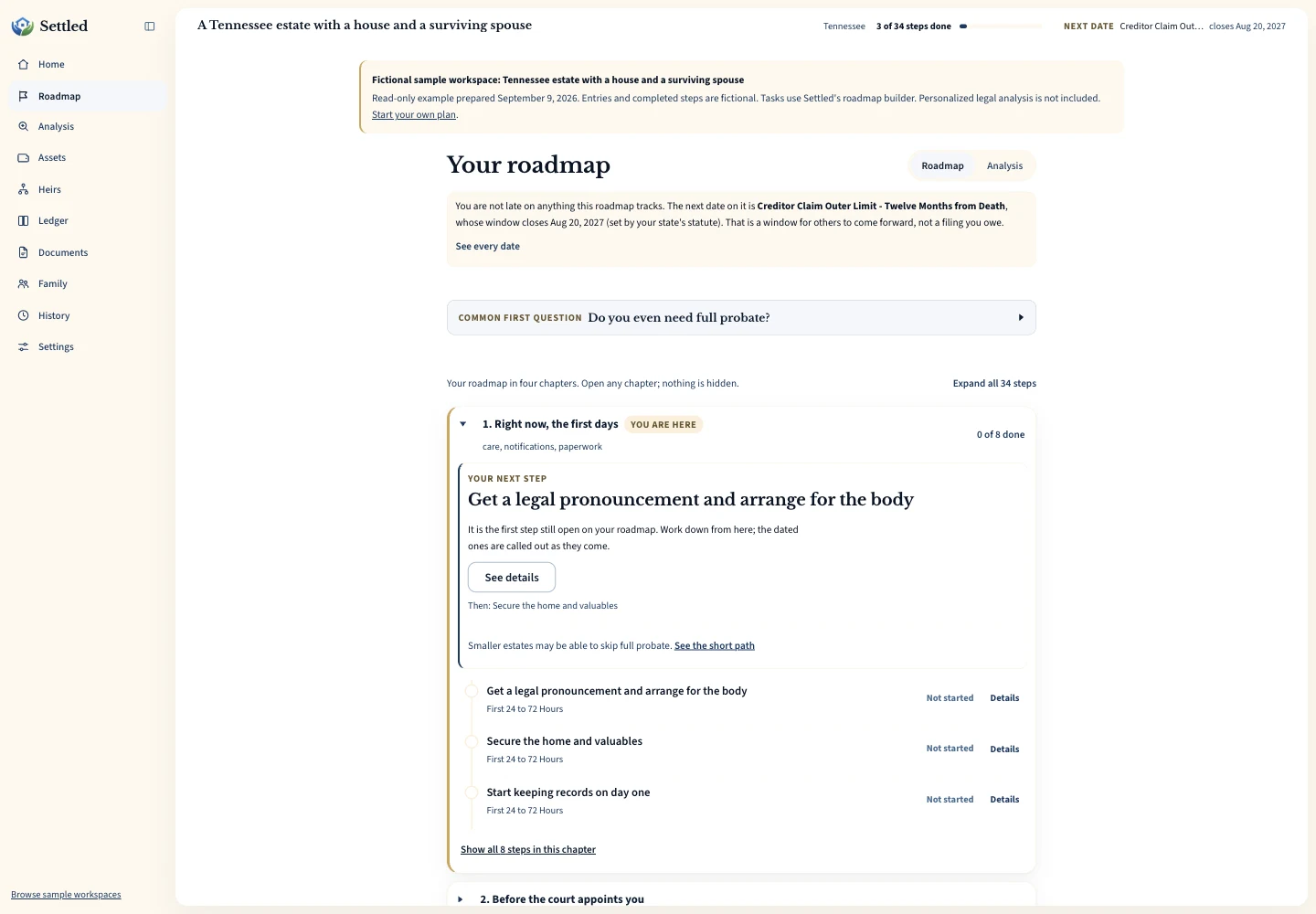
Inspect the same fictional records as a PDF summary, CSV ledger or data export.
Frequently Asked Questions
What is the best executor software for a family?
What is the best executor software for accounting?
Which executor software can I try free?
Which choice includes help from a person?
Why does this page have no overall ranking score?
Keep working through your options
Sources and checking dates
Product pages can change between checks. Confirm the price, included features and terms on the provider’s site before paying.
- The Settled Workspace. Settled Estate. Publication date not stated. Checked 2026-10-01.
- EstateExec official product site. EstateExec. Publication date not stated. Checked 2026-09-09.
- EstateExec Pricing. EstateExec. Publication date not stated. Checked 2026-09-09.
- EstateExec for Accounting. EstateExec. Publication date not stated. Checked 2026-09-09.
- SwiftProbate product and pricing. SwiftProbate. Publication date not stated. Checked 2026-09-09.
- SwiftProbate FAQ: free and Complete plans. SwiftProbate. Published Publication date not stated. Checked 2026-09-27.
- Pricing. Executor.org. Publication date not stated. Checked 2026-09-09.
- How it Works. Executor.org. Publication date not stated. Checked 2026-09-09.
- Probate and Estate Settlement for Families. Atticus. Publication date not stated. Checked 2026-09-09.
- Write high quality reviews. Google Search Central. Published Updated 2025-12-10. Checked 2026-09-09.
Settled Estate is not a law firm, and this content is for informational purposes only and does not constitute legal advice. Probate laws and procedures in your state can change. Consult with a qualified attorney for advice specific to your situation. Full disclaimer.