Settled vs EstateExec
Settled vs EstateExec comes down to price and financial depth. Settled Estate costs $19.99 once per estate and covers 50 published states and D.C. EstateExec costs $199 once per estate, offers a 10-day trial, and publishes stronger bank-download, accounting, report, and view-only sharing features. Settled price checked October 1, 2026; competitor prices checked September 9, 2026.
Free preview and 10 assistant questions. Working tools cost $19.99 once per estate. See what is included.
By Settled Estate Editorial Team · Checked
Choose Settled when one family estate needs a lower-cost workspace for tasks, records, files, collaborators, and file-based transaction import. Choose EstateExec when direct bank download, more mature estate-accounting features, or separate view and edit permissions justify the added cost. Neither product supplies legal representation.
What we checked. We inspected Settled product code and focused accounting, import, date, invitation, and entitlement tests. We checked EstateExec public product, pricing, and accounting pages on September 9, 2026. We did not create or buy an EstateExec account.
How should you decide: Settled vs EstateExec?
EstateExec has the clearer case for an estate with heavy financial work. Its public accounting page lists integrated asset, expense, and distribution records, one-click inventory and accounting reports, direct bank import, executor fee calculations, cost-basis features, attachments, and PDF or CSV export. It also publishes view or edit access for other people. Review EstateExec's accounting claims.
Settled has the clearer case when a family wants one estate workspace at a lower one-time price. It tracks assets, transactions, expenses, reimbursements, gains and losses, cash versus assets still held, and distributions. It accepts CSV or pasted transaction data and builds a charge-and-discharge view. Its tasks, contacts, documents, and collaborator workspace keep financial records beside the rest of the work. Review Settled's current offer.
Scroll across to compare all columns.
| Decision point | Settled | EstateExec |
|---|---|---|
| Published price | $19.99 once per estate | $199 once per estate after a 10-day trial |
| Transaction intake | CSV, TSV, paste, or manual entry; no live bank feed | Optional direct bank transaction download; $19.99 per year after the first included year |
| Financial fit | Family recordkeeping, charge-and-discharge structure, expenses, reimbursements, distributions, and reports | Deeper published accounting system with bank import, cost-basis features, fee calculations, inventory, and accounting reports |
| Sharing | Collaborators can edit estate information; no read-only heir portal | Published edit or view permissions, including access for co-executors, lawyers, or heirs |
| Guidance | State-shaped workspace across 50 published states and D.C. | State-specific plan, duties, task links, examples, due dates, and references |
| Evidence used here | Code inspection and focused tests; no fresh paid production walkthrough | Public pages only; no account or paid walkthrough |
How do Settled and EstateExec prices compare?
Settled's complete workspace is $19.99 once for one estate. EstateExec's public pricing is $199 once for one estate after a 10-day trial. EstateExec says the trial needs no credit card, email, or registration. It also says extra users do not cost more. Direct bank download is included for the first year, then listed at $19.99 per year. See EstateExec pricing.
The plain purchase gap is $179.01. That gap can matter for a small estate with a few accounts and a manageable number of transactions. It can matter less when the executor would otherwise spend hours cleaning bank exports, identifying transfers, or shaping a report. EstateExec's bank download and accounting links address that heavier case.
Do not compare the $19.99 and $199 figures as though the products carry the same financial tools. Ask what the estate will need. If monthly statements already export clean CSV files and the executor is comfortable reviewing mappings, Settled's file import may be enough. If a long administration will produce many entries and regular accounting work, EstateExec may earn its higher price.
Both prices apply per estate. EstateExec publishes volume discounts and a multi-estate dashboard for estate professionals who contact the company. Settled's comparison here concerns its consumer complete plan. We found no basis for inventing professional Settled tiers or comparing unpublished quotes.
What does the accounting difference mean during real work?
Consider a fictional estate with a home sale, two investment accounts, a checking account, $14,000 in expenses, executor reimbursements, and four beneficiaries. The executor must explain opening values, sales, income, debts, expenses, cash, property still held, and distributions.
In Settled, the executor can import bank data from a file, review mappings, classify records, connect financial activity to the estate record, and use the accounting model to separate cash from assets still held. Each import accepts up to 500 rows. That is workable for many family estates, but it is still a file workflow. The executor must download, import, review, and correct the data. Settled does not claim that the ledger has reconciled to an external bank statement.
EstateExec says it can download transactions from an estate bank account, identify distributions and debt payments, and help ensure accounts reconcile. It also publishes integrated records for assets, expenses, and distributions, plus inventory and accounting reports. Those are EstateExec's published descriptions, not findings from our own account test.
The difference matters at three points. First, transaction intake can save repeated export work. Second, linked estate-accounting fields can reduce duplicate entry when a sale touches an asset, cashflow, distribution, and final report. Third, permission levels can let a lawyer or beneficiary inspect information without editing it. EstateExec publishes view and edit options; Settled currently invites collaborators who can work in the shared estate.
Neither product removes the executor's duty to check source records. A calculated balance can be internally consistent while a statement item is missing. A formatted accounting report can still require a local form, schedules, supporting papers, beneficiary consent, or court review. Confirm the required accounting form and reporting period with the court, lawyer, or accountant for the matter.
Rubric, strengths, and product limits
Our rubric weighs six questions: Does guidance reflect the estate facts? Can the executor maintain assets, debts, contacts, tasks, and files? How do transactions enter and reports leave? What access can another person receive? What help exists? What is the full price for the expected term? We publish no score because our EstateExec evidence comes from public pages rather than paid use. The review standard we follow asks for evidence and drawbacks.
Reasons to choose Settled
- The $19.99 one-time price is $179.01 below EstateExec's regular estate license.
- The workspace joins task guidance, records, documents, collaborators, and a financial model for one family estate.
- File import gives the executor control over which bank data enters the workspace.
- Settled currently supports 50 states and D.C.
Settled limitations
- No direct bank feed is established; imports use files, pasted data, or manual entry.
- Collaborators can edit estate information. Settled does not offer a read-only beneficiary portal.
- The public sample is read-only; it does not let you test imports or collaboration.
- Coverage stops at 50 states and D.C., and product output is not a promise of court acceptance.
Reasons to choose EstateExec
- Its published accounting scope is wider, with bank download, integrated records, inventory, accounting reports, cost-basis features, and executor fee calculations.
- It publishes separate view and edit access, which may suit a lawyer, co-executor, or heir.
- The 10-day trial gives a buyer a chance to inspect the workflow before buying.
- Estate professionals can ask about volume pricing and a multi-estate dashboard.
EstateExec limitations
- The regular price is $199 per estate, five times Settled's present one-time price after rounding.
- Bank download carries a $19.99 yearly fee after the included first year.
- A small estate may not need its wider accounting setup or professional features.
- State guidance and calculations remain informational. The executor still must verify legal, tax, filing, and reporting decisions.
How should you decide between Settled and EstateExec?
Choose Settled if the estate is in a published state, the family wants a lower one-time cost, CSV or manual transaction entry is acceptable, and collaborators can share working access. Review the Settled accounting workflow before paying so the records and output match the job you expect.
Choose EstateExec if bank download, detailed estate accounting, view-only sharing, or professional multi-estate work carries enough value to cover the higher price. Use its 10-day trial to inspect the fields, report layout, permission choices, and state material for your estate. A trial can show fit without proving that a generated report meets a court's requirements.
Keep a lawyer or accountant in the decision when the estate has disputed authority, uncertain title, tax filings, insolvent debts, contested distributions, fiduciary-accounting questions, or a court order you do not understand. Software can keep facts and work together. It cannot make a legal judgment or take responsibility for a filing.
If both products appear suitable, use EstateExec's published trial with fictional data and compare it with Settled's preview and feature pages. Look for the fields and report your estate actually needs. Record the full purchase and add-on costs before deciding. A familiar screen should not outweigh missing permissions, import support, or an unusable final output.
Review the choice again after listing the people involved. EstateExec's view permission may suit a beneficiary or advisor who should inspect without changing records. Settled's collaborator access better suits someone who will help do the work. If the estate needs both roles, ask each vendor to show the exact permission path and export a sample status report before placing private documents in the account.
Also compare the source-to-report chain. Start with one statement entry and one receipt, then follow them through import, classification, correction, attachment, and final report. The better product is the one whose chain the executor can explain and review. Direct bank download can reduce entry work, but it still needs statement checks. File import creates another step, but it may give the executor more control over what enters.
See the working tools
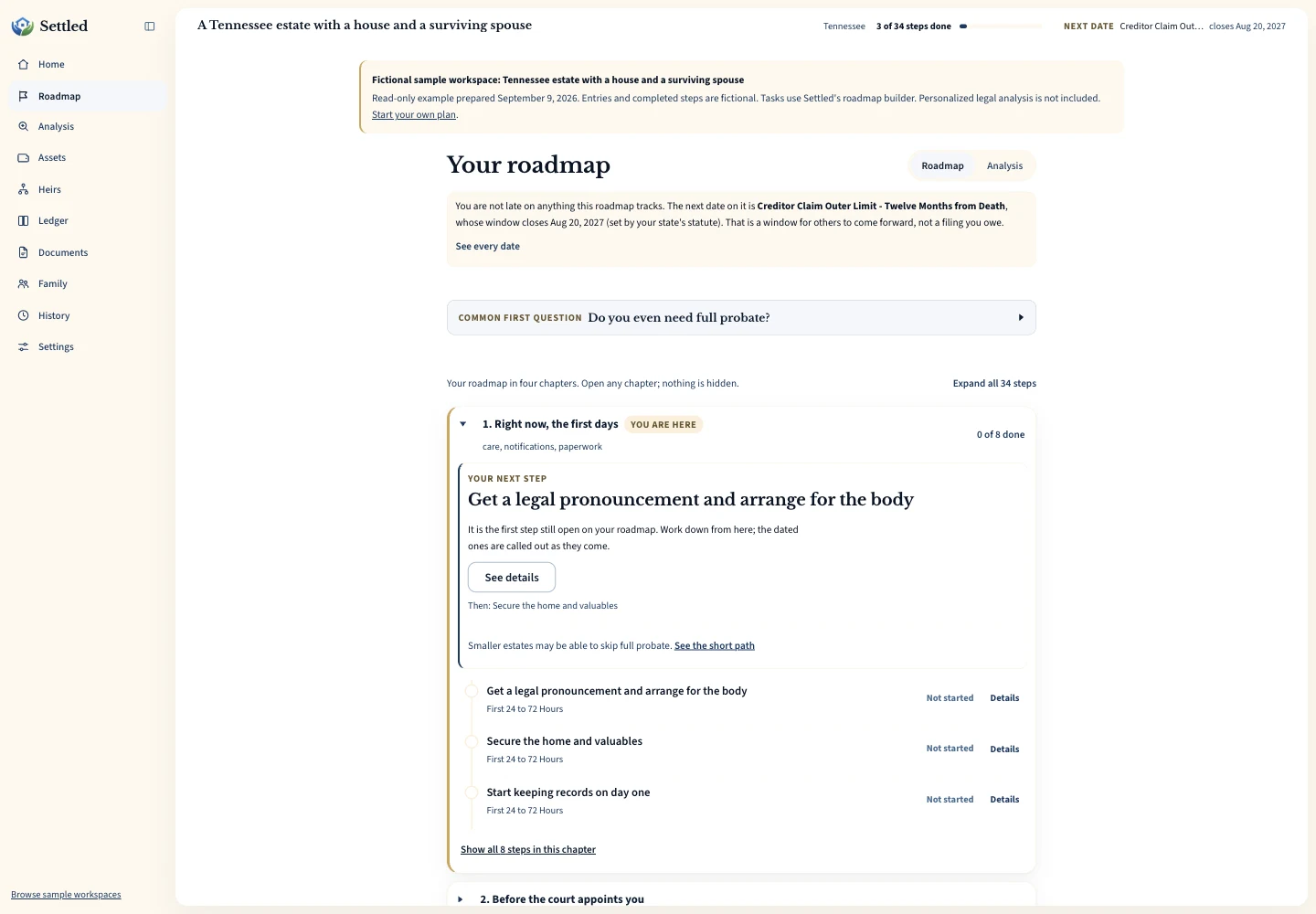
Inspect the same fictional records as a PDF summary, CSV ledger or data export.
Frequently Asked Questions
Is EstateExec an active Settled affiliate?
Does EstateExec cost $199 once or every year?
Does Settled connect directly to a bank?
Can beneficiaries have read-only access?
Which tool is better for estate accounting?
Keep working through your options
See how Settled organizes tasks, records, money, documents, and shared work.
Review methodologyRead how we check product claims and handle our interest in Settled.
Executor software choicesCompare the main options by the work an estate requires.
Compare with spreadsheetsSee what manual records gain and what they require the executor to maintain.
Sources and checking dates
Product pages can change between checks. Confirm the price, included features and terms on the provider’s site before paying.
- The Settled Workspace. Settled Estate. Publication date not stated. Checked 2026-10-01.
- EstateExec official product site. EstateExec. Publication date not stated. Checked 2026-09-09.
- EstateExec Pricing. EstateExec. Publication date not stated. Checked 2026-09-09.
- EstateExec for Accounting. EstateExec. Publication date not stated. Checked 2026-09-09.
- Write high quality reviews. Google Search Central. Published Updated 2025-12-10. Checked 2026-09-09.
Settled Estate is not a law firm, and this content is for informational purposes only and does not constitute legal advice. Probate laws and procedures in your state can change. Consult with a qualified attorney for advice specific to your situation. Full disclaimer.