Settled vs Executor.org
Settled vs Executor.org compares a $19.99 one-time estate workspace with a plan advertised at $8 a month and billed as $96 a year. Settled Estate has clearer financial-record evidence. Executor.org gives greater prominence to its personalized assistant, state forms, task instructions, reminders, and data vault. Settled price checked October 1, 2026; competitor prices checked September 9, 2026.
Free preview and 10 assistant questions. Working tools cost $19.99 once per estate. See what is included.

By Settled Estate Editorial Team · Checked
Settled fits an executor who wants a lower one-time price and a working estate record with file-based transaction import and accounting calculations. Executor.org fits someone drawn to a guided plan, conversational assistant, state forms, reminders, and a central vault. The public evidence does not support a claim that one product handles every part of an estate.
What we checked. We inspected Settled code and focused tests. We checked Executor.org public pricing and how-it-works pages on September 9, 2026. We did not open or buy an Executor.org account, test its assistant, or inspect paid vault controls.
What separates Settled vs Executor.org?
Settled's differentiator is the estate record behind the task list. It records assets, heirs, contacts, transactions, expenses, reimbursements, distributions, documents, collaborators, and exports. It accepts bank data through CSV, TSV, pasted rows, or manual entry. Its accounting separates cash from assets still held and records gains and losses. See Settled's current product page.
Executor.org's public experience centers on a questionnaire, a state-shaped plan, ordered tasks, instructions, document checklists, time estimates, an assistant, reminders, and a Data Vault. The vault is described as a place for contacts, accounts, real estate, and documents, with export or sharing for lawyers, accountants, or family. See how Executor.org describes the workflow.
Scroll across to compare all columns.
| Decision point | Settled | Executor.org |
|---|---|---|
| Published cost | $19.99 once per estate | $8 per month, billed annually at $96 |
| State access | 50 published states and D.C. | Public pages advertise state-specific plans and forms; verify access for the estate state |
| Guided work | Estate-shaped tasks, conditional dates, reminders, source navigation, and records | Questionnaire, prioritized plan, task dependencies, instructions, time estimates, forms, reminders, and assistant |
| Financial records | Transactions, file import, assets, expenses, reimbursements, gains and losses, distributions, and accounting views | Data Vault names financial accounts and total value; reviewed pages do not explain a complete estate-accounting workflow |
| Sharing | Collaborators can edit estate information; no read-only heir portal | Vendor says vault information can be exported or shared; public page does not detail paid permission levels |
| Support evidence | Product guidance and support; no legal advice | Personalized assistant advertised around the clock; no hands-on answer-quality test here |
How does one-time pricing compare with annual billing?
Settled charges $19.99 once for the complete workspace for one estate. Executor.org displays $8 per month, then states that it bills $96 annually. Its pricing page also advertises a 30-day money-back guarantee. Check Executor.org's current billing terms.
The first-year difference is $76.01. If access continued into a second billed year at the same terms, the total would reach $192. That is an arithmetic scenario, not a statement that a user will be charged twice. Buyers should confirm renewal, cancellation, continued export, and refund terms at checkout. Estate administrations often cross a year boundary, so renewal terms matter even when the monthly display looks small.
A recurring plan may be reasonable when a vendor continues providing an assistant, reminders, updated guidance, or hosted records. A one-time estate plan may be more predictable for someone who wants a workspace available through a long administration without tracking a renewal. The buyer should compare the help they expect to use, not just divide the annual price by twelve.
Executor.org also labels its fee reimbursable by the estate. Reimbursement is a legal and accounting question that can depend on authority, reasonableness, local rules, the will, court review, and estate circumstances. Keep the receipt and ask counsel or the court when the treatment is unclear. Neither vendor can promise reimbursement for every estate.
How should you evaluate the Executor.org assistant and task plan?
Executor.org says its assistant knows the user's state, estate details, and plan and can answer questions around the clock. Its task pages advertise plain-language instructions, needed documents, time estimates, forms, and suggestions. Those features can reduce the need to search across disconnected pages when the user wants to know what to do next.
Our review did not submit questions to the assistant. We cannot assess the accuracy, citations, refusal behavior, correction path, or treatment of ambiguous facts. Before relying on any estate assistant, ask it for the source and checked date behind a legal statement. Compare the answer with the relevant court, statute, agency page, or lawyer. Save the source you actually relied on.
Settled's dated work can use death, appointment, publication, and conditional events rather than treating the date of death as the only anchor. That can make a task list more useful after appointment. It remains dependent on correct user inputs and rules. A generated reminder does not extend a legal deadline or show that notice was completed.
Use a fictional estate to evaluate both products. Include a will, an out-of-state property, an estate checking account, an unpaid creditor, and a co-executor. Ask which facts change the plan, how a completed task records proof, what happens when an appointment date changes, and where the legal source appears. A polished answer matters less than whether the user can trace, correct, and document the work.
Which product better supports estate records and accounting?
Settled has the stronger evidence for transaction-level estate records in this review. Its accounting and import workflow supports classification, mapped file imports, estate expenses, executor reimbursements, asset sales, gains and losses, cash, property still held, and distributions. That makes it a better starting point when the executor expects to use the workspace as a financial record.
Executor.org's Data Vault page lists contacts, financial accounts, real estate, documents, estate value, export, and sharing. Its public explanation does not show enough accounting detail to judge transaction import, classifications, reimbursements, sale gains, distribution schedules, reconciliation, or final accounting reports. Marketing silence does not prove a feature is absent. It means a buyer should ask for a demonstration before treating the vault as accounting software.
Settled also has limits. It has no live bank feed. Its file import requires the executor to obtain and review source data, and a calculated balance does not prove reconciliation with a bank statement. Its PDF summaries carry a verification disclaimer and should not be called court-approved forms. The executor still owns the source records and final review.
If financial work is the deciding factor, write down the output required at the end of the next reporting period. Ask each vendor to show how a bank entry, asset sale, reimbursement, and beneficiary distribution flow into that output. If the answer stays at “store financial accounts,” the product may be an organized vault without the accounting structure the estate needs.
Fair reasons to choose each product and their limits
We apply the same rubric to tasks, records, money, sharing, help, and full cost. We publish no score because Executor.org received a public-page review rather than account testing. Our review reference calls for evidence and meaningful drawbacks.
Reasons to choose Settled
- The one-time price is lower than one year of Executor.org at current published rates.
- It has a more clearly defined transaction and accounting record.
- Tasks, people, property, documents, and money share one estate workspace.
- Users can import files without granting a live bank connection.
Settled limitations
- Coverage currently reaches 50 states and D.C., so the estate state may be unavailable.
- There is no live bank feed or read-only heir portal.
- Collaborators can edit, which may be broader access than a beneficiary should receive.
- The public sample is read-only; it does not let you test imports or collaboration.
Reasons to choose Executor.org
- The assistant is central to the product and advertised as available around the clock.
- Tasks include instructions, document lists, time estimates, and state forms.
- The Data Vault provides a clear home for contacts, property, accounts, and documents.
- Its 30-day money-back guarantee provides an initial period to assess fit.
Executor.org limitations
- The $8 monthly display requires $96 annual billing.
- The reviewed pages do not explain transaction import or a final estate-accounting report.
- Public descriptions do not establish detailed sharing permissions for family, lawyers, and accountants.
- We did not test the assistant, so answer accuracy and source handling remain unverified.
Who should choose Settled or Executor.org?
Choose Settled when the estate is in a supported state, one-time pricing matters, and the executor needs a combined task and financial workspace with file-based imports. Review its accounting workflow and document organization against the estate's expected output.
Choose Executor.org when conversational help, task instructions, state forms, time estimates, and a central vault matter more than the price difference. Ask for a demonstration of accounting and permission details if those are part of your job. Use the refund window promptly if the actual workflow does not match the published description.
Bring a lawyer into disputed, high-value, tax-sensitive, insolvent, or multi-state matters when rights or required filings are uncertain. Product guidance can help frame the question and organize the papers. It does not create an attorney-client relationship.
Before deciding, ask Executor.org to show the path from an assistant answer to a cited legal source and then to a completed task with supporting proof. Ask Settled to show the path from a transaction file to a corrected entry and downloadable report. These two short demonstrations test the part each product emphasizes and expose whether the missing part will require another tool.
See the working tools
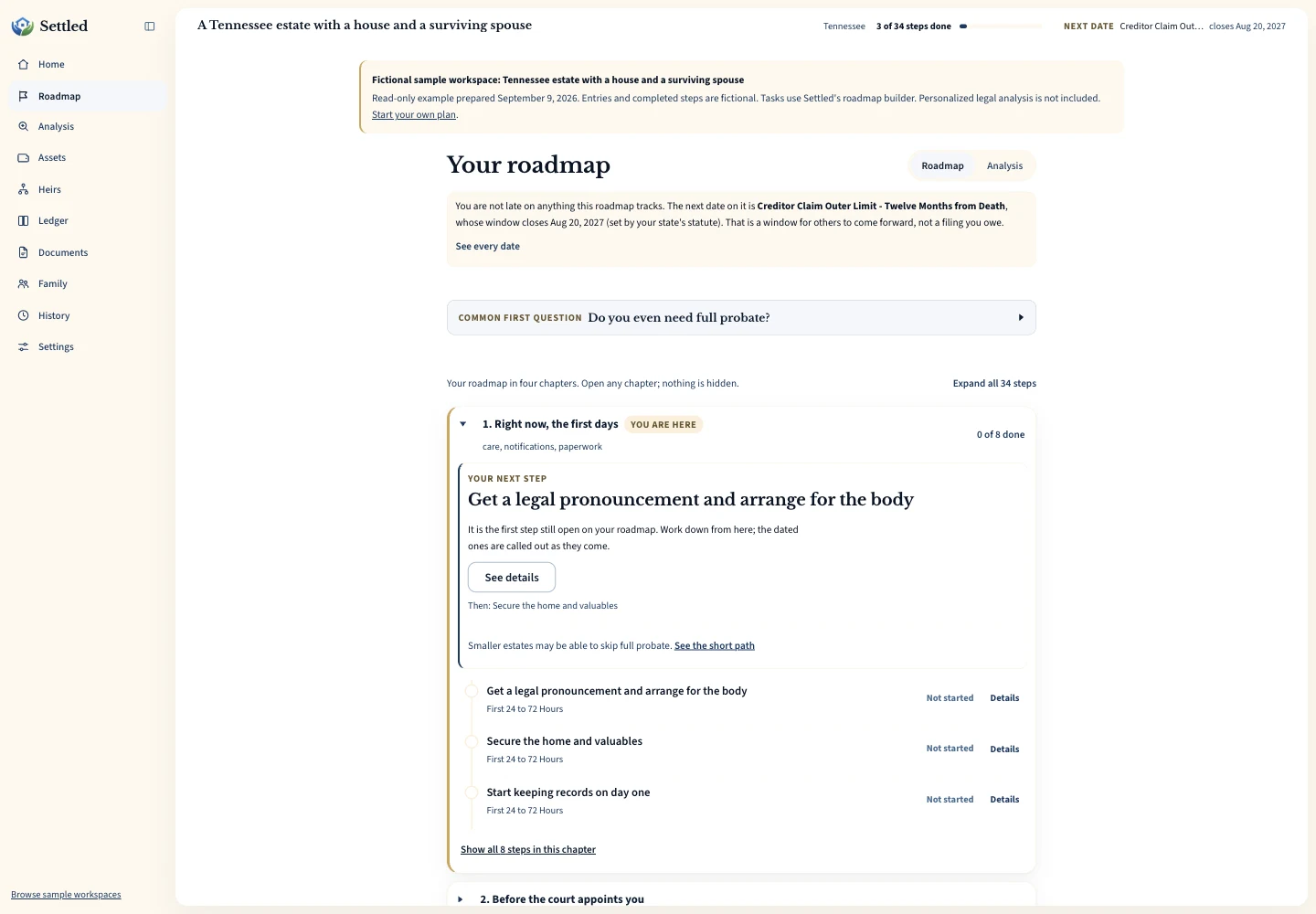
Inspect the same fictional records as a PDF summary, CSV ledger or data export.
Frequently Asked Questions
Does Executor.org cost $8 or $96?
Did Settled test the Executor.org assistant?
Which has clearer accounting features?
Can I share either product with family?
Can the estate reimburse either subscription or purchase?
Keep working through your options
Sources and checking dates
Product pages can change between checks. Confirm the price, included features and terms on the provider’s site before paying.
- The Settled Workspace. Settled Estate. Publication date not stated. Checked 2026-10-01.
- Pricing. Executor.org. Publication date not stated. Checked 2026-09-09.
- How it Works. Executor.org. Publication date not stated. Checked 2026-09-09.
- Write high quality reviews. Google Search Central. Published Updated 2025-12-10. Checked 2026-09-09.
Settled Estate is not a law firm, and this content is for informational purposes only and does not constitute legal advice. Probate laws and procedures in your state can change. Consult with a qualified attorney for advice specific to your situation. Full disclaimer.