Executor expense tracker for estate payments
Executor expense tracker tools in Settled Estate keep personal outlays with the estate ledger. the preview is free and the complete plan costs $19.99 once per estate. Offer checked 2026-10-01.
Free preview and 10 assistant questions. Working tools cost $19.99 once per estate. See what is included.

By Settled Estate Editorial Team · Checked
Small payments become hard to explain when they live in a wallet, an email thread, and three bank accounts. Settled gives an executor or family helper a specific reimbursable entry for a cost paid personally, alongside separate categories for estate money in, estate money out, and distributions. The distinction preserves who paid and what has happened so far.
Recording a cost does not make it reimbursable under local law or approve repayment. Settled also does not track time or mileage as a dedicated compensation log. Use the workspace for the factual record, keep the receipt, and ask the court, attorney, or accountant whether the estate may repay the item. The executor expenses guide explains the broader reimbursement and compensation questions.
What we checked. Settled reviewed the current ledger categories, import flow, accounting treatment, document workspace, and paid entitlement on September 9, 2026. No reimbursement decision, court approval, or tax treatment was tested.
See the working tools
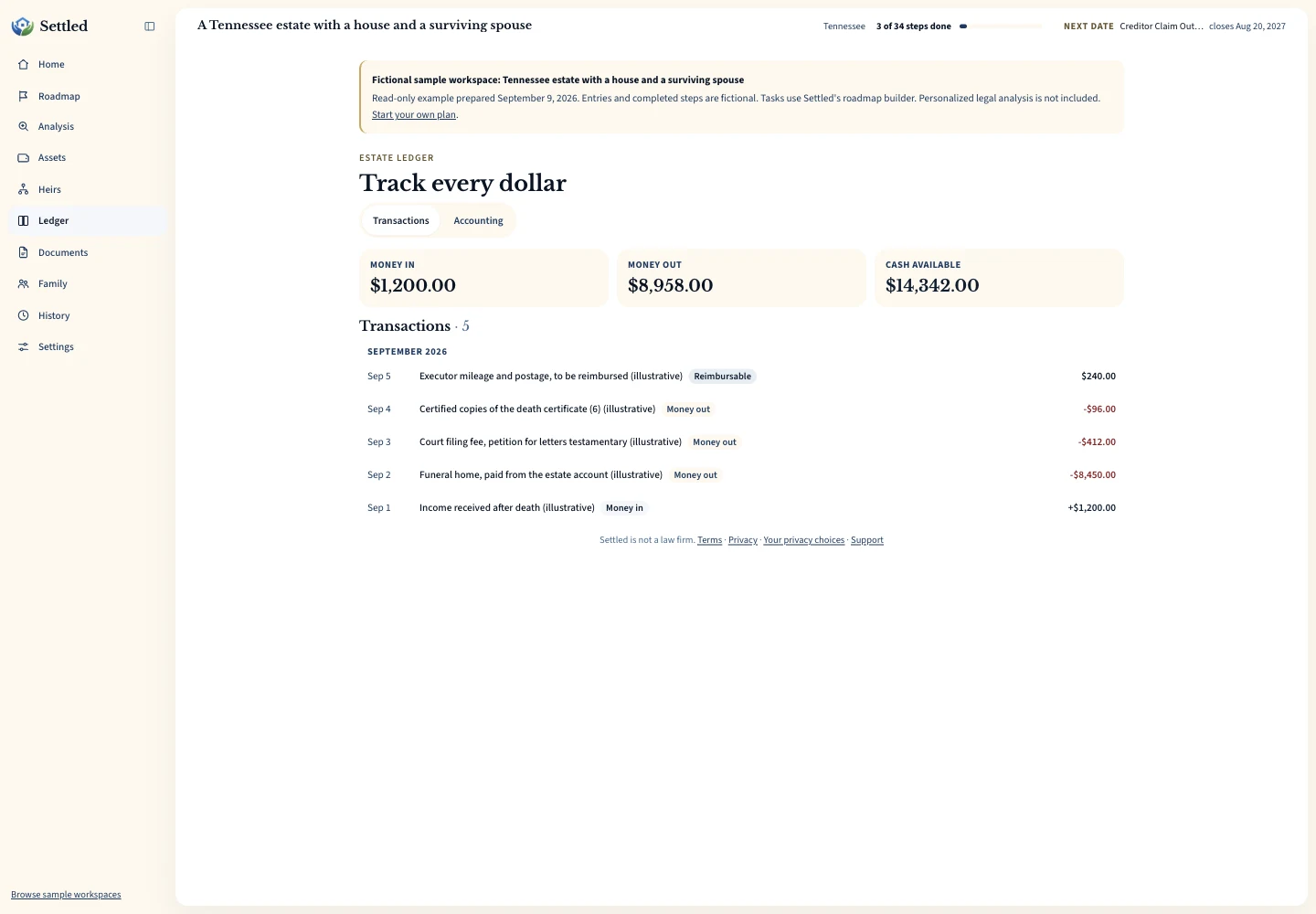
Inspect the same fictional records as a PDF summary, CSV ledger or data export.
Keep four records distinct in an executor expense tracker
First, an estate payment uses estate funds to pay an estate bill. Second, a personal outlay uses the executor's or helper's money for an estate-related cost. Third, a reimbursement occurs when estate funds later repay that person. Fourth, executor compensation pays for services or time under the law, will, court order, or agreement that applies. One event can lead to another, but they should not collapse into one vague “expense” line.
Settled's reimbursable category records the personal outlay. The accounting view tracks that amount separately from bills paid with estate cash. When repayment occurs, record the estate-side transaction according to the actual event and retain the link between the outlay and repayment in the description and supporting records. This makes it possible to see an unpaid reimbursable balance without treating it as cash already gone from the estate.
Compensation needs its own review. IRS Publication 559 states that personal representative fees received from an estate are included in gross income and explains different federal reporting treatment depending on whether serving as an executor is part of a trade or business. Read the current IRS publication and speak with a tax professional. A reimbursement entry is not a compensation calculation.
What to record for each executor expense
Enter the date the payment occurred, the amount paid, and a description that states the vendor or recipient and the estate purpose. Include the person who paid in the description when more than one helper spends personal money. A good record could read, “Jordan paid county certified-copy fee for three copies.” It tells the reviewer what happened without turning a note into a legal conclusion.
Save the receipt, invoice, order confirmation, or cancelled-check image in the document workspace. Give the file a name that can be matched to the ledger entry, such as the date, vendor, and amount. If the receipt covers personal and estate items together, preserve the full receipt and explain the estate portion. Do not rewrite the source document to make it fit the desired result.
Add context while it is fresh. Note whether the payment was urgent, who requested it, and whether anyone has reviewed it. Settled provides the place to store the record; it does not offer an approval status that makes the estate legally responsible. A plain note such as “ask attorney whether repayable” is better than marking an uncertain item as settled.
Use the tracker across the real course of an estate
Early outlays may include certified copies, court filing charges, postage, property security, or an urgent utility bill. Later records may involve appraisal charges, cleanout, storage, professional invoices, transfer charges, or travel connected with estate work. These are examples of costs people may encounter, not a statement that every item is payable by the estate. The governing law, will, court orders, and facts control.
The person paying matters. A sibling who has not been appointed may buy locks or pay for a death certificate while helping the family. Record the factual outlay without describing that person as an executor if the court has not appointed them. If the appointed representative later considers repayment, the record shows the source, date, purpose, and supporting file.
Keep recurring property expenses distinct. A mortgage, insurance premium, repair, and sale cost all relate to the same home but answer different accounting questions. Use descriptions and dates that preserve those differences. Link the property in your notes, then review the entries alongside the estate inventoryand recorded sale proceeds.
Protect the boundary between personal and estate money
A tracker works best when the financial accounts also stay separate. Avoid using a personal checking account as the estate's general operating account when an authorized estate account is available and appropriate. Ask the bank what appointment papers, tax identification, and account documents it requires. The FDIC explains that banks may ask someone seeking another person's account information for a death certificate and court appointment proof. See the FDIC consumer guidance.
If a personal outlay cannot be avoided, enter it promptly. Do not net it against cash you received for the estate or quietly remove it from a later distribution. A separate entry and receipt let the representative and reviewer decide how to handle it. When repayment occurs, the estate bank statement should show the payment and the records should identify the person repaid.
The same boundary applies to family helpers. A collaborator can add or edit estate records, but access to Settled does not authorize use of the estate bank account. The financial organization and appointment documents control that authority. Use family sharing for work that the representative has chosen to delegate, and reserve financial actions for the people who are authorized to take them.
Use imports for estate transactions and manual entries for personal outlays
Once an estate account is open, its bank or spreadsheet export can supply many ledger rows. Settled accepts CSV and TSV files and lets you map transaction columns before import. Review whether the file's debits and credits point in the expected direction. Keep the original export and compare the imported date range with the statement.
A personal outlay often needs a manual reimbursable entry because it will not appear in the estate account. If a later reimbursement appears in an imported bank file, make the descriptions easy to pair. Duplicate detection looks for a matching date, amount, and normalized description. It can identify a repeated row, but it cannot match a personal receipt to a repayment or decide that the amount was permitted.
Review the ledger by person as well as category. Ask which helper still has unpaid items, which reimbursements lack receipts, and which estate payments have unclear descriptions. Resolve the support before the account is prepared for beneficiaries, a professional, or the court. The work is easier when each month is reviewed while statements and memories are available.
Questions to ask before an expense is repaid
Ask who paid, what the estate received, when the cost arose, and what source document proves the amount. Then ask whether the payer had authority, whether the cost was reasonable, and whether local law, the will, or a court order addresses it. Settled can help you preserve the first set of facts. A qualified reviewer handles the legal and tax judgment.
Check timing and available cash. An apparently valid cost may compete with higher-priority debts or a needed reserve. IRS Publication 559 warns personal representatives about federal tax responsibilities and potential personal exposure in an insolvent estate. Do not treat a positive software balance as permission to reimburse or distribute funds while creditor or tax questions remain open.
Check whether the item is really compensation. A flat amount labeled “executor expenses” may combine fees for time with repayment of dollars spent. Split the record. Keep time and service notes outside Settled if compensation rules require them, because the current product does not provide a dedicated time or mileage log. Ask a tax professional how any fee and repayment should be reported.
Prepare an expense record another person can review
Before a meeting, sort open reimbursable items into three groups: supported and ready for review, missing a document, and waiting on a legal or tax answer. Export the estate data and download the estate packet if those formats help the reviewer. Bring original bank statements and receipts as well. The packet summarizes entered information; it is not a substitute for its source records.
State the limits plainly. Tell the reviewer which expenses were paid personally, which were paid from estate funds, which reimbursements have occurred, and which entries came from an import. Identify any dates or descriptions you inferred. That candor lets an attorney or accountant spend time on the uncertain decisions instead of assuming the software has already validated them.
Settled's current product offer gives 10 assistant questions with the free preview. The$19.99 complete plan for one estate opens the ledger, documents, packet, full generated plan details in exports, and unlimited assistant questions. CSV and JSON exports of your own entered records remain available without a plan. Review the current offer at the Settled workspace page, then decide whether the record connection is worth paying for in your estate.
Frequently Asked Questions
Does entering an expense mean the estate must reimburse it?
Can Settled track executor time and mileage?
Where should I keep receipts?
How do reimbursements affect the accounting?
Can a family collaborator add an expense?
Keep working through your options
Learn the difference between repayment, compensation, and estate bills.
Estate accounting softwareSee how reimbursements flow into the wider financial record.
Estate document organizationKeep receipts, invoices, statements, and appointment records together.
Executor software overviewReview the complete task, asset, money, document, and family workflow.
Sources and checking dates
Product pages can change between checks. Confirm the price, included features and terms on the provider’s site before paying.
- The Settled Workspace: Probate, Step by Step. Settled Estate. Publication date not stated. Checked 2026-10-01.
- Publication 559 (2025), Survivors, Executors, and Administrators. Internal Revenue Service. Published 2026. Checked 2026-09-09.
- How to Find a Long Lost Bank Account or Safe Deposit Box. Federal Deposit Insurance Corporation. Published December 2020. Checked 2026-09-09.
Settled Estate is not a law firm, and this content is for informational purposes only and does not constitute legal advice. Probate laws and procedures in your state can change. Consult with a qualified attorney for advice specific to your situation. Full disclaimer.