Estate inventory software for the assets you find
Estate inventory software in Settled Estate records assets, values, transfer questions, and sales. the free preview comes first and the complete plan costs $19.99 once per estate. Offer checked 2026-10-01.
Free preview and 10 assistant questions. Working tools cost $19.99 once per estate. See what is included.

By Settled Estate Editorial Team · Checked
An estate inventory is both a search and a record. You begin with statements and property someone already knows about, then add items discovered in mail, tax records, titles, and account history. Settled holds each asset with its type, reference, location where relevant, value, beneficiary-status answer, and any later sale proceeds.
The software does not decide ownership or inheritance. A joint title, trust, beneficiary form, transfer-on-death arrangement, or state rule may affect whether property enters probate. Use “unknown” until you have checked the controlling record. The estate inventory guide explains the legal purpose and documents that may be involved.
What we checked. Settled reviewed the current asset fields, beneficiary-status handling, asset-sale workflow, accounting calculations, and paid gates on September 9, 2026. The review did not verify any user-entered valuation, title conclusion, or local inventory form.
See the working tools
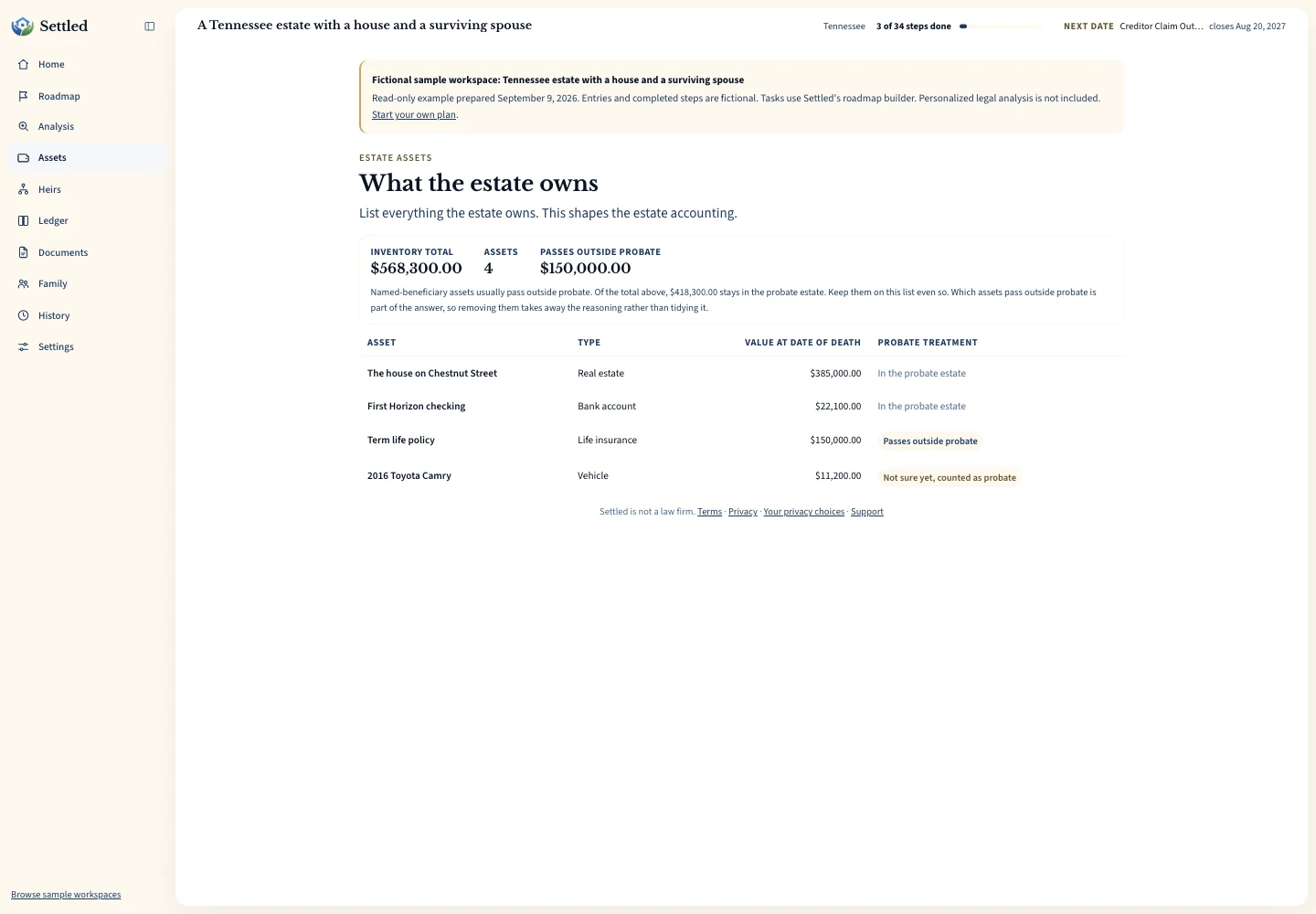
Inspect the same fictional records as a PDF summary, CSV ledger or data export.
What to record in estate inventory software
Name the asset so another person can identify it without opening every file. “Checking at Community Bank ending 1842” is more useful than “bank account.” Choose the closest asset type, add a non-secret reference, and record the property location for real estate. Avoid placing full account numbers or passwords in a description written for routine review.
Add the date-of-death value when a reliable source becomes available. Keep the statement, appraisal, market record, or other support used for that figure. If no value is known, leave it unset and add the valuation work to the task plan. A partial inventory that names its gaps is more useful than a final-looking total built from guesses.
Select whether the asset had a named beneficiary or similar transfer arrangement. Settled accepts yes, no, or unknown because early information is often incomplete. Review the actual account contract, deed, title, or trust record. A family member's memory may identify where to look, but it does not establish the legal transfer path.
Turn the inventory into an asset search plan
Start with the decedent's recent mail, email, tax returns, wallet, files, and recurring deposits or withdrawals. List banks, brokerages, retirement plans, insurance carriers, employers, vehicles, real property, business interests, personal property with material financial or family importance, debts owed to the decedent, and expected refunds. Record a lead even when its value and ownership are still unknown.
Use tasks for the next request and the inventory for the asset itself. A task might say “ask brokerage for date-of-death statement,” while the asset record holds the account name and later value. Store the received statement in the document workspace. This keeps the question, answer, and support connected without treating the task title as financial data.
Organizations can require proof before releasing information. The FDIC says a bank may ask someone seeking another person's account information for a death certificate and court appointment proof. Review the FDIC consumer articleand contact the bank for its current process. Settled cannot obtain records or establish your authority with the organization.
Keep probate status open until the transfer facts are known
The gross list of things connected with a person is not the same as the probate inventory. A payable-on-death account, jointly owned property with survivorship, a retirement account with a beneficiary, or property held in a trust may follow a different transfer path. The governing document and state law matter. Marking “yes” for a named beneficiary keeps the recorded value outside Settled's probate accounting column.
“Unknown” protects the decision while research continues. It lets the workspace flag the missing classification and prevents a quiet assumption that the asset passes through the estate. Once you verify the record, update the answer and retain the document that supports it. If beneficiaries, title documents, and account representatives disagree, pause and ask an attorney.
The IRS warns that the legal owner of property can affect whether an estate or beneficiary reports gain or loss on a sale, and says to consult local law for that ownership question. See Publication 559. Settled's classification is an entered fact used for organization. It does not make the underlying legal determination.
Record values with their source and date
“Value” can refer to different things: a statement balance, appraised fair market value, assessed value, sale price, or net proceeds after costs. Settled's asset field is the recorded date-of-death value for the estate inventory. Do not substitute a later sale check without explaining the difference. Keep both records when both events matter.
Use the source suited to the property and the purpose. A financial organization can provide a statement for an account. A qualified appraiser may be needed for real estate, a business, or unusual personal property. An accountant or attorney can explain which date and method apply to a filing or tax question. The software stores the number you enter; it does not appraise the property.
Review old estimates when a better source arrives. Preserve the supporting document and note why the figure changed. A reviewer should be able to distinguish a placeholder used for planning from the value used in a filed inventory or tax analysis. Do not infer precision from the fact that a screen can total the entries to the cent.
Carry an asset sale into the estate accounting once
When an inventoried asset sells, enter the net sale proceeds on that asset. Settled compares the proceeds with the recorded date-of-death value and sends the difference to the gain or loss portion of its charge-and-discharge statement. The asset then contributes cash rather than remaining property to the balance-on-hand calculation.
Do not enter the full sale proceeds again as ordinary money in within this accounting calculation. The inventory already charged the representative with the asset's recorded value, so a second full receipt would duplicate it. Record separate income such as rent, interest, or a refund in the ledger. Keep the closing statement and invoices so a reviewer can check the net figure.
The software calculation is not a tax conclusion. Publication 559 explains that an estate can realize gain or loss and that the result may depend on ownership and how the property was held. Ask a tax professional about basis, expenses, character, and reporting. Ask counsel whether the representative has authority or needs court approval before a sale.
Audit the inventory for gaps, duplicates, and unsupported answers
Review by source. Compare the inventory with the last tax return, known statements, property records, insurance papers, and mail. Then review by category to find an entire class that may be absent. Two passes catch different gaps. Keep a search note for organizations contacted and a clear task for any response still pending.
Ask relatives about property without treating recollection as ownership proof. A family member may know about a storage unit, loan to a friend, collection, online account, or safe deposit box that does not appear in the obvious files. Record the lead, identify where it came from, and verify it through a statement, title, contract, inventory, or the organization holding the property.
Look for duplicates created by nicknames or new statements. “Main checking” and “Community Bank 1842” may be the same account. Confirm before removing either record. Look for one asset split across several accounts and for one jointly owned item entered at its full value when a filing may call for a different interest. Ask a professional about the correct reportable amount.
Filter attention toward missing value and unknown beneficiary status. Those labels point to unresolved work, not software errors. Review recorded sales against closing records and the ledger. Then compare the inventory total with any court filing before submission. Settled does not file the inventory or confirm that the local form uses the same categories.
Revisit the list before each major distribution and before final review. Assets can produce income, be sold, be abandoned as having no net value, or turn out to belong to someone else. Record what changed and keep the source. The inventory should tell the current story while preserving enough context for a reviewer to understand why it differs from the first draft.
Decide whether an estate inventory app fits your case
Settled fits when you want the asset record to feed the accounting and remain beside tasks, files, and family work. It is useful when ownership questions remain open and you want to preserve “unknown” rather than force a premature category. The free preview and 10 assistant questions let you assess the process before opening paid tools.
The complete plan costs $19.99 once for one estate. Review the current offer on the Settled product page. A professional fiduciary with many estates may need a multi-client system. A disputed, taxable, or hard-to-value estate may need attorneys, accountants, and appraisers even when the family also uses software to organize records.
Before choosing any tool, enter a fictional or non-sensitive test asset if the product permits it and inspect the fields. Ask whether you can leave value and transfer status open, record a sale without duplicating proceeds, retrieve the source file, and export the record. Choose the system whose uncertainty and handoff match the estate you actually have.
You can also inspect Settled's blank estate inventory template and filled fictional example. The example is invented for demonstration and does not show a real estate. Use it to compare the columns with the records you already keep before entering any private information.
Frequently Asked Questions
Does Settled decide which assets go through probate?
Can I leave an asset value blank?
How does Settled record a sale?
Does the inventory replace the court form?
Can a collaborator edit asset records?
Keep working through your options
Learn what an inventory does and how to approach asset discovery.
Estate accounting softwareSee how inventory values and sales enter the financial statement.
Organize estate documentsKeep statements, appraisals, deeds, and sale records near the work.
Executor software overviewReview the whole estate workspace and free preview.
Sources and checking dates
Product pages can change between checks. Confirm the price, included features and terms on the provider’s site before paying.
- The Settled Workspace: Probate, Step by Step. Settled Estate. Publication date not stated. Checked 2026-10-01.
- Publication 559 (2025), Survivors, Executors, and Administrators. Internal Revenue Service. Published 2026. Checked 2026-09-09.
- How to Find a Long Lost Bank Account or Safe Deposit Box. Federal Deposit Insurance Corporation. Published December 2020. Checked 2026-09-09.
Settled Estate is not a law firm, and this content is for informational purposes only and does not constitute legal advice. Probate laws and procedures in your state can change. Consult with a qualified attorney for advice specific to your situation. Full disclaimer.